
What your thyroid test results actually mean

Check three numbers first: TSH, free T4 and, where it’s been measured, free T3. TSH is the one your GP looks at first, and a common adult reference range sits around 0.4 to 4.0 mIU/L. High TSH alongside low free T4 usually points to an underactive thyroid; low TSH with high free T4 or free T3 usually points in the other direction, towards an overactive thyroid. If autoimmune disease is suspected, your clinician may add thyroid antibodies (TPOAb, TgAb or TSI) to the panel.
None of this replaces a conversation with whoever ordered the test. A single result is a snapshot, not a verdict.
- TSH: the pituitary’s signal to the thyroid, and usually the first marker checked
- Free T4: circulating thyroxine available to your tissues
- Free T3: the active hormone, added when symptoms don’t match TSH and free T4
- Antibodies: ordered when an autoimmune cause looks likely
Key Takeaways
Interpreting thyroid test results correctly means reading TSH, free T4 and free T3 together with symptoms and medication history, never as isolated numbers.
| Point | Details |
|---|---|
| TSH comes first | It’s the most sensitive screening marker; abnormal TSH triggers free T4 and sometimes free T3 testing. |
| Ranges are lab specific | Always check the reference interval printed on your own report, not a generic figure. |
| Patterns matter more than single numbers | High TSH with low free T4 differs clinically from high TSH with normal free T4. |
| Retest on a timeline | Most clinicians recheck levels several weeks after starting or adjusting levothyroxine, typically within a few months. |
| Normal labs don’t always mean no issue | Foodconnection’s functional testing looks at nutrient status and conversion issues when symptoms persist despite normal results. |
This article is general information, not a substitute for advice from a qualified doctor. Consult a qualified healthcare professional about your own circumstances before acting on anything here.
Table of Contents
- Understanding thyroid test results: what each marker measures
- Normal thyroid test range and how to read your report
- Common patterns in thyroid hormone levels and what they usually mean
- What can skew your thyroid panel interpretation
- What happens after abnormal thyroid test results
- Reading thyroid results alongside symptoms and nutrition
- Sources
Understanding thyroid test results: what each marker measures
TSH, free T4 and free T3 don’t measure the same thing, and mixing them up is where most confusion starts.
- TSH (thyroid stimulating hormone) comes from the pituitary gland, not the thyroid itself. It rises when the pituitary senses too little thyroid hormone circulating, and falls when there’s too much. That feedback loop is why TSH is the most sensitive first-line screen almost everywhere in the world.
- Free T4 is thyroxine that isn’t bound to carrier proteins, meaning it’s available for your cells to use. It’s checked whenever TSH comes back abnormal, to work out whether the thyroid itself is underproducing or overproducing hormone.
- Free T3 is the active hormone your body actually uses at the cellular level, converted from T4 in the liver, kidneys and elsewhere. It’s not part of every routine panel, but the Cleveland Clinic notes it’s useful when someone stays symptomatic despite normal TSH and free T4, since it can flag a conversion problem the standard two markers miss.
- Antibodies (TPOAb, TgAb, TSI) get added when the pattern suggests autoimmune thyroid disease, such as Hashimoto’s or Graves’. TPOAb and TgAb are typically checked for suspected Hashimoto’s; TSI supports a Graves’ diagnosis in someone with an overactive thyroid.
Free measurements matter because total T4 or total T3 can mislead when binding proteins shift, which happens during pregnancy or with oestrogen therapy. Free fractions strip that variable out.
Normal thyroid test range and how to read your report
Reference ranges printed on your report aren’t universal constants. They’re set by the individual laboratory, calibrated to its own equipment and population, so a mild difference between two labs is normal, not a red flag.
That said, commonly used adult ranges look roughly like this:
| Marker | Typical adult range | What it suggests |
|---|---|---|
| TSH | 0.4–4.0 mIU/L | High suggests hypothyroidism; low suggests hyperthyroidism |
| Free T4 | Varies by lab, check your report | Low with high TSH supports hypothyroidism; high with low TSH supports hyperthyroidism |
| Free T3 | Varies by lab, check your report | Used mainly when TSH and free T4 don’t explain symptoms |
A TSH of 6.0 mIU/L with a normal free T4 is a genuinely different situation to a TSH of 6.0 mIU/L with a low free T4, even though the TSH figure is identical. The first pattern is subclinical, the second is overt, and clinicians treat them differently.

Age and pregnancy shift these numbers further. A clinical review in PMC makes the point plainly: reference intervals should be lab specific and age or pregnancy specific, not treated as one fixed number for every patient. Always read your result against the range printed on your own report, not a figure you found online, including this one.
Common patterns in thyroid hormone levels and what they usually mean
Four combinations cover most of what you’ll see on a real report.
- High TSH, low free T4: primary hypothyroidism. The thyroid is underproducing and the pituitary is pushing harder to compensate.
- High TSH, normal free T4: subclinical hypothyroidism. Often monitored rather than treated immediately, particularly if symptoms are mild.
- Low TSH, high free T4 and/or free T3: hyperthyroidism or thyrotoxicosis. NHS guidance confirms this pattern usually points to an overactive thyroid, with diagnosis based on symptoms plus blood results together.
- Normal TSH, low free T3: sometimes a conversion issue, where T4 isn’t being turned into active T3 efficiently, or a medication effect. This is one of the patterns where a standard panel alone can leave real questions unanswered.
Pro Tip: If your TSH and free T4 both look “normal” but you still feel exhausted, cold, or foggy, ask specifically whether free T3 was tested. It often isn’t included by default, and it’s the marker most likely to explain a mismatch between numbers and symptoms.
Weight changes are one of the more common reasons people request a thyroid panel in the first place, and it’s worth reading results alongside a proper look at how hypothyroidism can drive weight gain rather than in isolation.
What can skew your thyroid panel interpretation
A handful of everyday factors can shift a result enough to cause confusion, and none of them mean anything is wrong with the thyroid itself.
- TSH follows a circadian rhythm, typically highest in early morning, so consistent morning testing gives more comparable results over time.
- Levothyroxine taken shortly before a blood draw, high-dose biotin supplements, and oestrogen-containing medication can all distort readings. Standard lab guidance advises against taking levothyroxine before testing for this reason.
- Pregnancy shifts reference ranges noticeably, and age does too, particularly in older adults where a slightly higher TSH may be unremarkable.
- Acute illness or a recent dose change can transiently push numbers around before things settle.
What happens after abnormal thyroid test results
Clinicians don’t treat every abnormal number the same way, and the decision usually rests on how far outside range the result sits and whether symptoms line up with it.
- Mild subclinical patterns are often monitored with a repeat test rather than treated straight away, especially with no antibodies and few symptoms.
- Clear overt patterns, meaning TSH clearly abnormal alongside an abnormal free T4, generally prompt treatment or dose adjustment sooner.
- Retesting after any dose change typically happens 6 to 12 weeks later, because levels and symptoms take time to stabilise and testing earlier risks an incorrect dose decision based on numbers that haven’t settled.
- Further investigation, such as antibody testing, thyroid ultrasound, radioactive iodine uptake scanning, or a biopsy, gets considered when a nodule is felt, imaging looks unusual, or the pattern doesn’t fit a straightforward diagnosis.
Symptoms that need urgent attention, rather than a routine follow-up, include a racing heartbeat with tremor and weight loss, or severe fatigue with confusion. Either pattern deserves same-week medical contact, not a wait-and-see approach.
Reading thyroid results alongside symptoms and nutrition
Numbers on a page never tell the whole story on their own. A result has to be read against symptoms, current medication, and sometimes what’s happening with iron, selenium and iodine status, since deficiencies in any of these can mimic or worsen thyroid symptoms even when the panel looks technically normal.
That’s the gap Foodconnection’s functional testing and interpretation work sits in. For people who’ve had a “normal” thyroid panel but still feel unwell, an expanded panel plus a proper look at diet, medication timing and lifestyle can surface what a standard two or three marker test misses.
- Persistent fatigue or brain fog despite normal TSH and free T4
- Suspected but unconfirmed autoimmune involvement
- Weight changes that don’t respond to usual dietary changes
- A wish to understand nutrient status (iron, selenium, iodine) alongside hormone levels
Diagnosis works best when lab numbers are read together with a person’s symptoms, history and medications, not in isolation. That principle underpins how functional lab testing gets used to fill gaps a routine panel leaves open.
A practical note before your results appointment
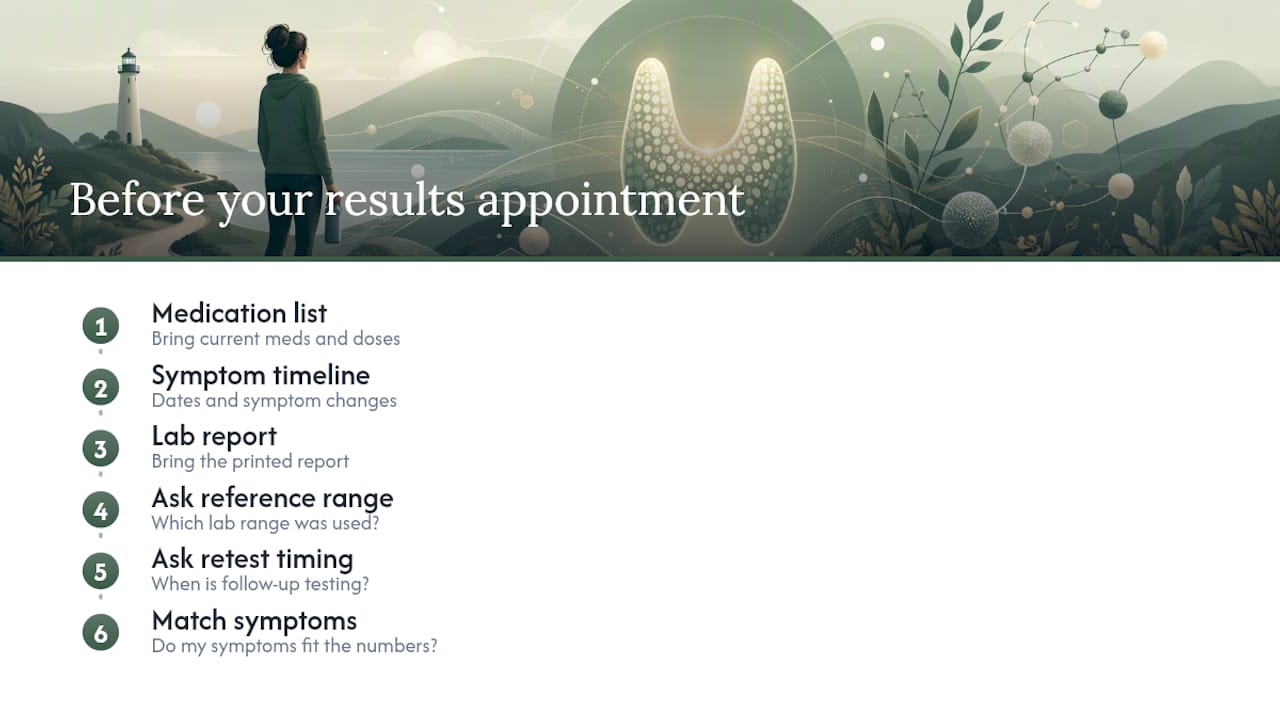
Bring your medication list, a timeline of symptoms, and the report itself. Ask which reference range your lab used, when retesting is planned, and whether your symptoms actually match the numbers.
Personalised support when your results don’t add up
Foodconnection is the option for readers who’ve had a thyroid panel come back “normal” on paper but still don’t feel right, without the six-month wait for a second GP referral. Where a routine test stops at TSH and free T4, Foodconnection’s functional lab testing and one-to-one interpretation looks at the wider picture: nutrient status, medication timing, and how your results relate to what you’re actually experiencing day to day.
This matters most for people whose symptoms, fatigue, weight changes, low mood, don’t line up neatly with a “normal” result. Foodconnection’s personalised nutrition programmes combine test interpretation with a structured plan built around your own history, rather than a single consultation and a printout. If that sounds like where you are right now, book an initial consultation and bring your last thyroid report with you.
Sources
- Thyroid function tests — Severn Pathology (NBT)
- Diagnosis — Overactive thyroid (hyperthyroidism) — NHS
- Clinical review: thyroid function testing and interpretation — PMC article
- Thyroid panel: what it is & results — Cleveland Clinic