
How to stick to a diet when it's a clinical programme, not a trend

To stick to a personalised nutrition programme you need ongoing, expert‑led support, not another one‑off meal plan. “Stick to diet,” in this context, means following a clinician‑designed plan built around your digestive, hormonal or energy‑related symptoms, with someone checking in as your body actually responds. The single biggest predictor of success is not willpower. It’s whether you have continuous, low‑burden contact with a practitioner who adjusts the plan as your symptoms change.
If you’re starting this week, do one thing first:
- Book your first check‑in and pick one symptom (bloating, energy, cycle regularity) to track daily, even loosely.
That single habit does more for long‑term adherence than any perfect first week of eating ever will.
Key Takeaways
Sticking to a personalised nutrition programme depends far more on continuous clinician contact and behavioural support than on the specific meal plan itself.
| Point | Details |
|---|---|
| Contact beats content | Frequent, low‑burden check‑ins predict adherence better than how detailed the meal plan is. |
| Use behaviour techniques | CBT, motivational interviewing and self‑monitoring measurably improve dietary adherence when combined. |
| Expect four to eight weeks | Habit formation typically takes this long; some symptoms ease sooner, others later. |
| Build in flexibility | Shifting eating windows or relaxing weekend rules sustains adherence better than rigid rules. |
| Choose ongoing support | Foodconnection’s programmes pair bespoke plans with regular check‑ins and optional lab testing. |
This article is general information, not a substitute for advice from a qualified doctor. Consult a qualified healthcare professional about your own circumstances before acting on anything here.
Table of Contents
- Why personalised plans need ongoing support to work
- What behaviour-change techniques do clinicians actually use?
- How often should check-ins happen to keep you on track?
- Why do people fall off their plan, and how do you fix it?
- How long does it take to feel like the plan is working?
- What does a clinician actually check for week to week?
- Why the standard adherence advice misses the point
- How Foodconnection helps you actually stick with it
- Sources
Why personalised plans need ongoing support to work
A meal plan without follow‑up is a snapshot, not a strategy. A review of randomised controlled trials on personalised nutrition found that genotype and biomarker data alone rarely sustain behaviour change unless paired with clinician counselling. The data tells you what’s wrong. It takes a person to help you act on it, week after week.
That pattern holds up in trial conditions too. One randomised trial comparing two levels of technology‑assisted personalised nutrition found that participants receiving dietitian video calls plus self‑monitoring showed greater dietary change at 12 weeks than those given automated feedback alone. The plan wasn’t the variable. The contact was.
Statistic callout: Personalisation plus counselling beats personalisation alone, according to the RCT evidence reviewed above, and the gap shows up specifically at the 12 week mark, not immediately.
What actually keeps people engaged, according to the research:
- Frequent, brief touchpoints that allow the plan to flex around your symptoms.
- Clinician interpretation of your data, not just delivery of it.
- Continuity, so adjustments build on what happened last week rather than starting cold.
What behaviour-change techniques do clinicians actually use?
Sticking to a plan long enough to feel better usually depends less on the food itself and more on how your practitioner handles setbacks, ambivalence and the small daily decisions between meals.
- Cognitive behavioural techniques (CBT) target the unhelpful thoughts that derail plans, like treating one difficult meal as proof the whole approach has failed. A clinician trained in CBT‑style reframing helps you catch that thought and correct it before it becomes a reason to quit.
- Motivational interviewing works differently. It’s less about correcting you and more about resolving your own ambivalence, letting you set goals you actually want rather than ones handed to you.
- Self‑monitoring, whether that’s a symptom log, a food and mood diary, or photos of meals, gives the clinician real data to adjust the plan rather than guessing.
A systematic review of behaviour‑change techniques in nutrition counselling found consistent evidence that these approaches, used together by qualified practitioners, improve dietary adherence more reliably than advice alone.
Pro Tip: Log symptoms, not just food. A pattern between what you ate and how you felt three hours later is far more motivating than a calorie count.

How often should check-ins happen to keep you on track?
The cadence of support matters as much as its content. Most clients start with an initial assessment, then move into short weekly or fortnightly check‑ins during the first month, tapering to monthly reviews once the plan stabilises. Each early check‑in tends to run 10 to 15 minutes, just long enough to flag what’s working and tweak what isn’t.
Formats vary deliberately, because rigid formats are part of why people drop off:
- Video or phone calls for anything nuanced or emotionally loaded.
- Secure messaging for quick questions between sessions.
- Asynchronous food photos or symptom logs, reviewed without needing a live call.
- Occasional SMS prompts as a light nudge, not a nag.
Flexibility is built in, not bolted on. Shifting an eating window by an hour, or relaxing rules on a weekend away, doesn’t derail a well‑designed programme. It’s expected. Evidence from time‑restricted eating research in IBS shows that this kind of flexibility rather than rigid compliance is often what separates people who keep the habit from those who abandon it within weeks. The clinician’s job is to hold the therapeutic goal steady while letting the daily execution bend.
Why do people fall off their plan, and how do you fix it?
Most drop‑outs trace back to one of four predictable problems, and each has a specific fix rather than a generic pep talk.
- Symptom flares. A short‑term tolerant swap list and a clear stop‑gap plan mean a bad gut day doesn’t become a reason to quit. Your clinician should tell you upfront when to pause the plan versus push through gently.
- Decision fatigue. Pre‑prepared meals, a simple meal‑replacement template, or a rule of “two choices per meal” removes the exhausting bit: deciding.
- Social events. A short boundary script (“I’m eating differently for a health reason, not being difficult”) and planning ahead, like eating a small snack before a party, keep your social life intact.
- Cost and time pressure. Low‑cost meal structures and asynchronous messaging support, rather than mandatory live calls, keep the programme workable on a tight week.
People managing chronic gastrointestinal conditions face extra layers here. Research on engagement barriers in GI health management points to anxiety, financial strain and time constraints as recurring obstacles, and flexible, multidisciplinary care pathways measurably reduce them.
Pro Tip: Keep a “bad day” folder, three meals you can make on autopilot when symptoms flare and thinking is hard. Decide them now, not at 6pm on a rough day.
How long does it take to feel like the plan is working?
Give it four to eight weeks before judging whether a change has become a habit. Some symptom relief, particularly bloating or energy shifts, can show up sooner; hormonal or cycle‑related markers often take longer to settle. That timeline lines up with adherence research on structured dietary interventions for IBS, which found habit formation typically requires several weeks, with support during the transition phase facilitating the difference between a trial and a lasting change.
Track progress against markers that actually move:
- Frequency and severity of your main symptom, logged weekly.
- Energy levels and sleep quality, which often shift before digestion fully settles.
- Functional outcomes, like whether you can eat out without dreading the aftermath.
- Where clinically indicated, validated lab markers such as thyroid panels or inflammatory markers.
If symptoms persist unexplained past that eight week mark, that’s the point to ask your clinician about functional testing rather than simply adjusting the diet further.
What does a clinician actually check for week to week?
A working programme runs on a short, repeatable checklist, not a fresh improvisation every session.
- What clients log: main symptom score, energy rating, one line on stress or sleep, and anything eaten outside the plan.
- What the check‑in covers: pattern review, one specific adjustment, and a plan for the week ahead.
- Standard responses: tolerant swaps for flare weeks, a pause‑and‑restart protocol, or a referral for testing if symptoms stall.
Two anonymised examples show how small this adjustment can be. One client with suspected histamine sensitivity kept missing check‑ins out of embarrassment about “failing”; moving to asynchronous photo logs instead of live calls solved it within a fortnight. Another, managing perimenopausal fatigue, was ready to quit until her plan shifted from three big meals to five smaller ones matched to her energy dips, a change spotted only because she’d been logging energy daily.
Most disease management happens at home, between appointments, which is exactly why the tools that reinforce what’s learned in a session matter as much as the session itself.
Foodconnection’s personalised nutrition programmes are built around this exact logic, continuity between sessions, not just advice within them.
Why the standard adherence advice misses the point
Most diet advice treats adherence as a discipline problem: try harder, plan better, want it more. That framing fails a specific group of people almost by design, those managing digestive disorders, hormonal imbalance or chronic fatigue, where symptoms genuinely change week to week and a rigid plan becomes unworkable by week three.
What the evidence actually supports is less romantic and more useful: adherence is a systems problem, not a motivation problem. Structured clinician support increases self‑efficacy and corrects unhelpful habits in a way that no amount of personal resolve reliably does alone. The plan matters less than the loop around it, the check‑ins, the adjustments, the permission to flex without quitting entirely.
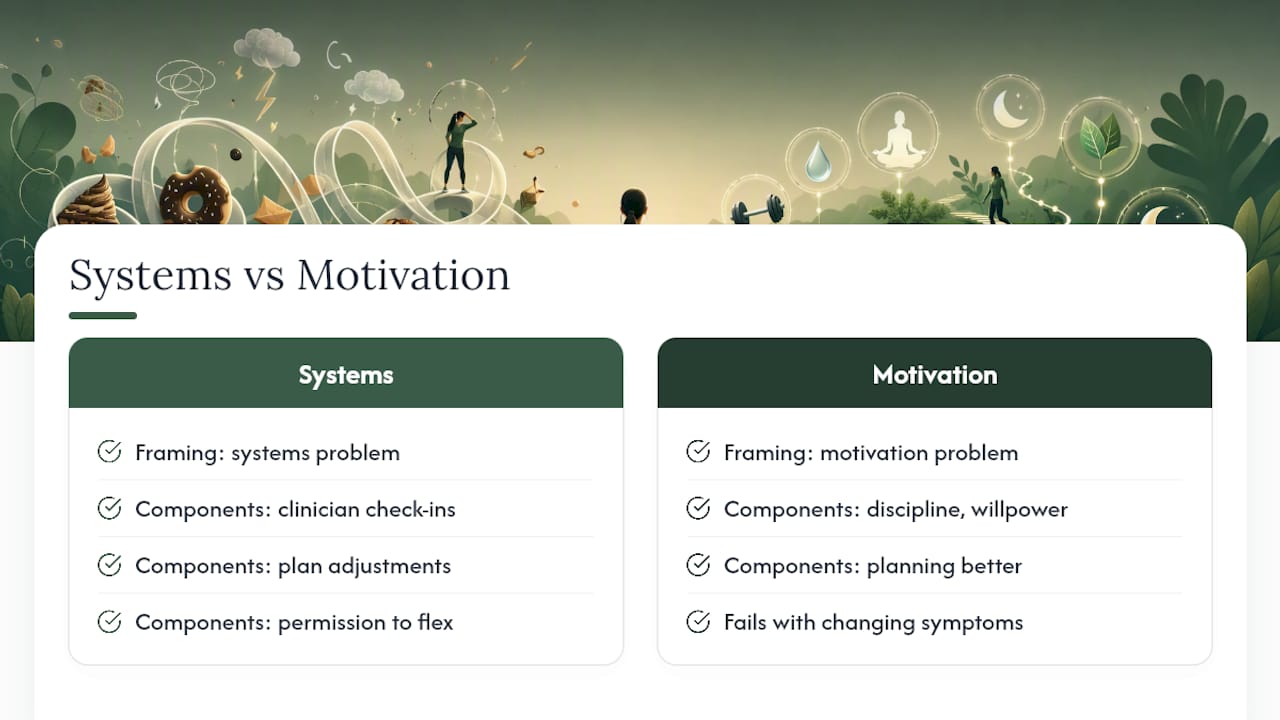
If there’s one thing worth prioritising above all else, it’s contact frequency over plan perfection. A slightly imperfect plan with weekly contact will outperform a flawless plan with none. Anyone choosing a programme should ask fewer questions about the meal plan itself and more about how often, and how easily, they can reach the person adjusting it.
How Foodconnection helps you actually stick with it
Most people don’t fail a nutrition plan because the food was wrong. They fail because nobody was checking in when their symptoms shifted or their week fell apart. Foodconnection is built around solving that specific problem, structured, ongoing programmes rather than a single consultation and a PDF.
Each programme includes regular check‑ins, a bespoke plan built around your symptoms rather than a generic template, optional functional lab testing where it’s clinically useful, and behavioural support to help the plan survive real weeks, not just good ones. It suits anyone managing digestive issues, hormonal imbalance, chronic fatigue or complex weight goals who wants a practitioner adjusting the plan with them, not just for them.
If sustained weight management within a chronic condition is your main goal, the weight loss support programme is built specifically for that. For a broader view of what’s included, including lab analysis and one‑to‑one support, the services page covers the full offering. Booking a first assessment is the practical next step, and it’s the point where a plan stops being generic advice and starts being yours.
Sources
- Key evidence for personalised nutrition: a review of randomised controlled trials
- Impact on dietary intake of two levels of technology‑assisted personalised nutrition: a randomised trial
Recommended
- Sustainable weight loss diet: a guide for chronic conditions | FoodConnection blog
- How to Choose the Right Nutritionist in London (And Avoid Costly Mistakes) | FoodConnection blog
- Why do I crash in the afternoon? | FoodConnection blog
- Cholesterol diet plan: what actually works for UK adults | FoodConnection blog