
Sleep and Weight: Fix Wake Time First, Evidence Based Steps

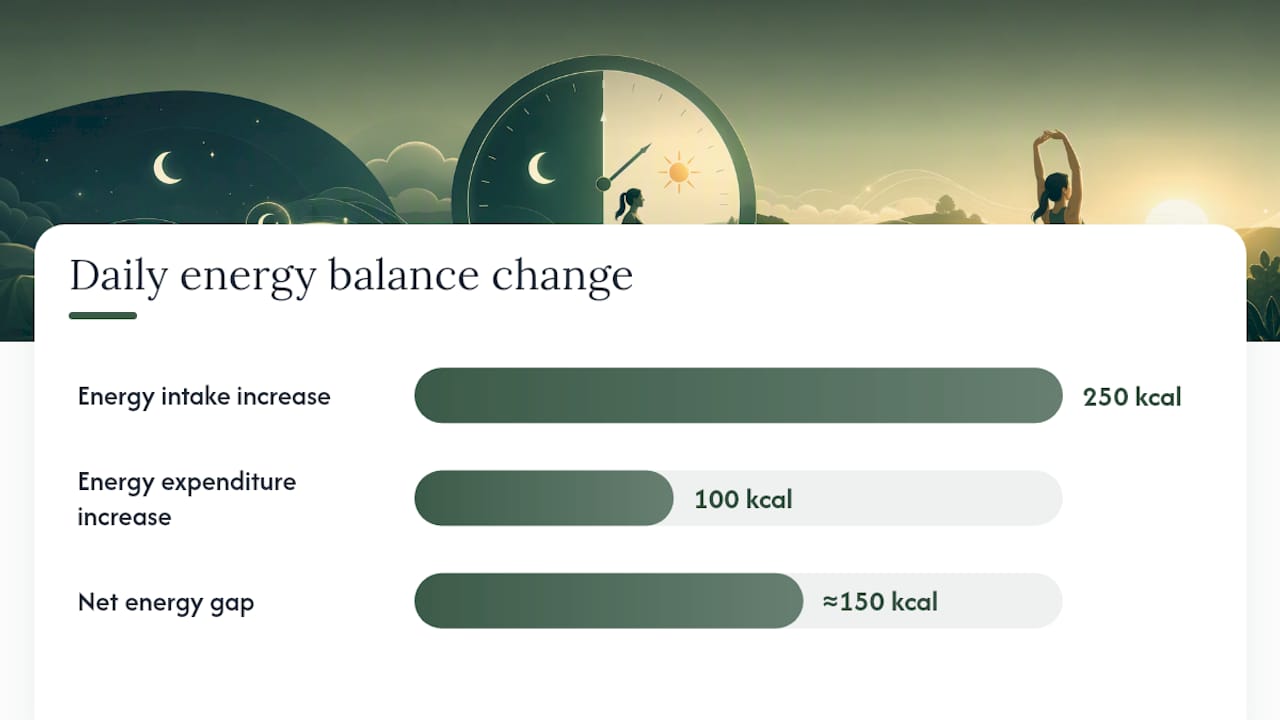
Yes, sleep affects weight, and mostly through appetite rather than activity. Poor sleep pushes people to eat more, not to burn less. Insufficient sleep raises daily energy intake by more than 250 kcal, while it only raises energy expenditure by around 100 kcal. That imbalance, repeated night after night, is where sleep-related weight gain actually comes from. The sections below walk through the evidence, the biology, and what to do about it.
TL;DR:
- Short sleep increases daily energy intake by over 250 kcal, which far exceeds the roughly 100 kcal increase in energy expenditure, promoting weight gain.
- Optimal sleep duration for weight management appears to be between seven and eight hours per night, with deviations on either side raising body fat risks.
- Interventions like cognitive behavioral therapy for insomnia and sleep hygiene programs can lead to modest weight loss, especially in overweight or poor sleepers.
- Poor sleep rewires appetite hormones and impairs impulse control, leading to increased cravings for high-calorie foods and greater late-night snacking.
- Consistently fixing wake times and gradually extending sleep are practical steps that support appetite control and complement dietary efforts for weight management.
Table of Contents
- How the evidence links sleep duration and quality with weight
- Mechanisms: hormones, energy balance and the brain’s role in cravings
- What sleep-improvement interventions show for weight: trials and meta-analyses
- Practical sleep steps that support appetite control and weight management
- Dietary patterns and meal timing that support better sleep (and so may help weight)
- When to suspect a sleep disorder and seek clinical help
- FoodConnection perspective: combining sleep work with personalised nutrition programmes
- What the research actually tells us about sleep and weight
- Sources
How the evidence links sleep duration and quality with weight
Population studies keep finding the same pattern: people who sleep too little, and sometimes those who sleep too much, carry more body fat than those in the middle. Researchers call this a U-shaped risk curve. Several large reviews find the lowest average BMI clusters around seven to eight hours a night, with risk climbing on either side of that range. It is not a hard cutoff, and individual variation is real, but the pattern shows up across enough cohorts to take seriously.
Experimental work backs up the observational data. A Columbia University trial cut sleep by roughly 80 minutes a night for six weeks and found participants gained about 1 pound on average, alongside more sedentary behaviour during the day. That is a modest number over six weeks, but stretched across a year of chronically short sleep, the maths stops looking trivial.
The clinical trial evidence on fixing sleep is more mixed. A systematic review and meta-analysis pooling behavioural sleep interventions found real, measurable effects on weight and BMI, but the size of the benefit varied a lot by study design and population. Cognitive behavioural therapy for insomnia (CBT‑I) and structured sleep-hygiene programmes tended to outperform simple “go to bed earlier” instructions.
A few things temper how confidently we can read this evidence:
- Many trials rely on self-reported sleep diaries rather than objective measures like actigraphy or polysomnography, which weakens precision.
- Sample sizes in sleep-extension trials are often small, making it hard to separate a genuine effect from noise.
- Most intervention studies run for weeks, not years, so long-term weight maintenance is still an open question.
- Effects tend to be strongest in people who start with either poor sleep quality or existing overweight, not in already lean, well-rested sleepers.
None of that undermines the core finding. It just means “sleep more, lose weight” is a real but modest lever, not a silver bullet.
Mechanisms: hormones, energy balance and the brain’s role in cravings
Short sleep does not simply make you hungrier in some vague sense. It rewires the specific hormones that regulate appetite and reward, and it does so quickly, often after just one or two poor nights. Ghrelin, the hormone that signals hunger, tends to rise with sleep restriction, while leptin, which signals fullness, tends to fall. PYY, another satiety-related hormone, is also affected in some studies, though the evidence there is less consistent than for ghrelin and leptin.
Sleep loss functions as a genuine metabolic stressor. It doesn’t just make you tired. It shifts how your body allocates and stores energy, nudging the whole system towards fat gain rather than simply draining your willpower for one evening.
That framing, drawn from recent work describing sleep loss as a metabolic disorder in its own right, matters because it moves the conversation away from “just eat less” and towards addressing the sleep deficit directly.
The energy balance numbers are the clearest signal in the whole research field. Insufficient sleep increases energy intake by over 250 kcal a day on average, while raising energy expenditure by only around 100 kcal a day. Put simply: tired bodies burn slightly more but eat considerably more, and that gap compounds daily.
The behavioural side may matter even more than the hormones. Sleep deprivation impairs prefrontal cortex function, the brain region responsible for impulse control, while heightening reward-centre responses to high-calorie foods. That combination explains why a bad night often ends in reaching for biscuits rather than fruit. Circadian misalignment, such as eating late at night when the body’s internal clock expects rest, appears to compound this further, independent of total sleep duration.
What sleep-improvement interventions show for weight: trials and meta-analyses
The strongest experimental evidence for a sleep-weight link comes from behavioural interventions, not observational studies. A 2026 systematic review and meta-analysis of behavioural sleep programmes, including CBT‑I and structured sleep hygiene, found average BMI reductions of 0.64 kg/m² across adult participants. Among people with obesity specifically, the average weight loss reached around 5.55 kg, a considerably larger effect than in the general population.
The same body of research found sleep interventions cut daily energy intake by an average of 147.5 kcal per day overall, rising to roughly 238 kcal per day among overweight and obese participants. That is a meaningful clue about mechanism: people eating less, not moving more, appears to drive most of the weight change.
A few distinctions worth flagging:
- CBT‑I style programmes, which combine cognitive restructuring with behavioural sleep rules, consistently outperformed basic “extend your sleep” instructions.
- Effects were largest in people who started with either poor sleep quality or existing excess weight, smaller in already lean, good sleepers.
- Timeframes in most trials ran several weeks to a few months, so expect gradual change rather than a rapid drop.
Realistically, sleep work alone is a moderate lever. It works best stacked alongside dietary changes rather than as a stand-alone weight-loss strategy.
Practical sleep steps that support appetite control and weight management
Small, sustained changes beat dramatic overnight fixes. Here is a sequence worth trying, roughly in order of impact:
- Fix your wake time first. A consistent wake time, seven days a week, anchors your circadian rhythm more reliably than trying to force an earlier bedtime.
- Extend sleep gradually. Add 15 to 30 minutes per week rather than attempting an extra two hours overnight; clinical practice suggests stepwise changes are easier to sustain and show earlier appetite benefits.
- Cut off eating two to three hours before bed. Late, large meals disrupt both sleep quality and next-day appetite regulation.
- Limit screens for the last 30 to 60 minutes before bed. Blue light and stimulating content both delay the natural release of melatonin.
- Watch caffeine and alcohol timing. Caffeine after early afternoon and alcohol within a few hours of bed both fragment deep sleep, even when they don’t feel like they’re keeping you awake.
- Consider CBT‑I if insomnia is chronic. For anyone dealing with persistent sleep difficulty rather than occasional bad nights, a structured programme tends to outperform generic sleep-hygiene tips alone.
Pro Tip: Keep a simple sleep diary alongside a weekly appetite and weight log for four weeks. Note bedtime, wake time, and a rough hunger rating each evening. Patterns that are invisible night to night often become obvious once you see them side by side.
Dietary patterns and meal timing that support better sleep (and so may help weight)
There is no single “sleep superfood,” but whole dietary patterns show a real association with better sleep. Mediterranean and DASH-style diets are linked to longer, more sufficient sleep in population and Mendelian randomisation research, with legumes, nuts, and whole grains showing the most consistent protective signal.
What to avoid close to bedtime matters just as much as what to add:
- Large, heavy, fatty meals within two to three hours of sleep, which slow digestion and can disrupt deep sleep stages.
- High-sugar fizzy drinks in the evening, which spike blood glucose and can trigger a rebound dip that disturbs sleep mid-cycle.
- Excess alcohol, which may bring on sleep faster but fragments it later in the night.
A practical evening template: a moderate portion of lean protein, a serving of vegetables, and a small amount of whole grains a few hours before bed, with a light snack such as a handful of nuts or plain yoghurt if genuine hunger strikes later. Certain food choices that support satiety in the evening can also reduce the late-night snacking cycle that shorter sleep tends to provoke.
When to suspect a sleep disorder and seek clinical help
Not every sleep-weight problem is fixable with better habits. Loud snoring, gasping or choking during sleep, and significant daytime sleepiness despite adequate hours in bed are classic signs of obstructive sleep apnoea (OSA). Chronic difficulty falling or staying asleep for three months or more points towards clinical insomnia rather than simple poor habits.
OSA and obesity interact in both directions: excess weight raises OSA risk, and untreated OSA disrupts the same hormonal and metabolic pathways already strained by short sleep, often worsening insulin resistance. This creates a cycle that lifestyle tweaks alone rarely break.
If any of this sounds familiar:
- Speak to a GP about a sleep assessment rather than assuming it will resolve on its own.
- Ask about screening tools such as the STOP‑Bang questionnaire, home oximetry, or a referral for polysomnography.
- Treatment options range from CPAP therapy for OSA to structured CBT‑I for chronic insomnia, both of which have downstream effects on appetite and metabolic health.
FoodConnection perspective: combining sleep work with personalised nutrition programmes
Sleep rarely improves in isolation from diet and stress, which is why Foodconnection builds sleep hygiene and stress-reduction techniques directly into personalised nutrition plans focused on basketball performance rather than treating them as a separate concern. Structured, ongoing support tends to translate sleep improvements into actual behaviour change more reliably than one-off advice, because appetite, stress, and sleep quality all move together, not independently. Continuous coaching, paired with optional functional lab testing where hormonal or metabolic factors are suspected, gives a fuller picture than generic tips ever can.
What the research actually tells us about sleep and weight
The honest reading of this evidence is that sleep is a real lever on weight, but a modest one, and the conventional advice oversells it in one direction while underselling it in another. Headlines love to say “sleep more, lose weight” as though it were a substitute for dietary change. It isn’t. The BMI reductions in the strongest trials are meaningful but small on their own.
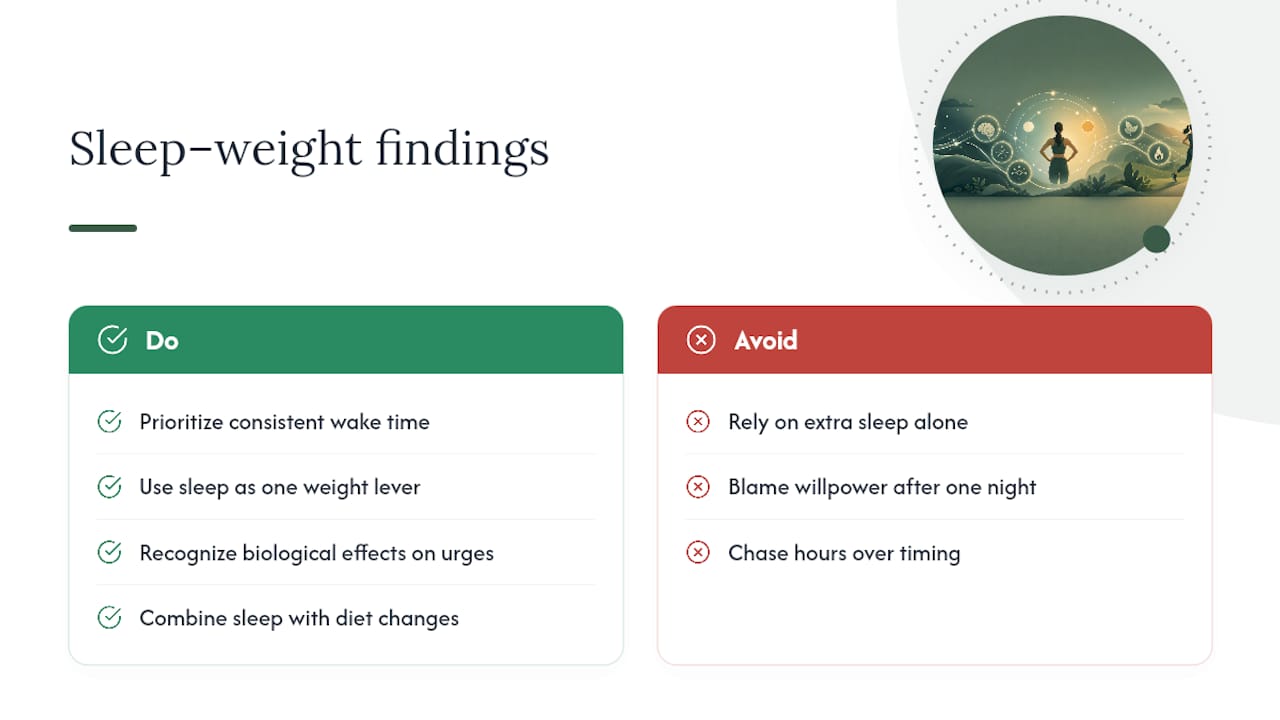
What gets underestimated is the mechanism. This isn’t really about willpower collapsing when you’re tired. It’s measurable hormonal and neural change, hitting impulse control and food reward simultaneously, on nights most people wouldn’t even flag as “bad sleep.” That reframes the whole problem. You’re not failing at self-control after a rough night. Your biology has shifted the odds against you.
If there’s one place to start, it’s consistency of wake time over chasing extra hours. It’s unglamorous, it’s not what most sleep content pushes, but it’s the piece with the clearest evidence behind it.
— Irina
This article is general information, not a substitute for advice from a qualified doctor. Consult a qualified healthcare professional about your own circumstances before acting on anything here.
Sources
The Nature Reviews Endocrinology paper quantifies the intake-versus-expenditure gap driving sleep-related weight gain. The obesity reviews meta-analysis and its companion Birmingham findings provide the strongest trial-level evidence on interventions. The Columbia study and PMC review supply the population and experimental context.
If you want structured support putting any of this into practice, Foodconnection’s weight loss programmes and broader nutrition services, including one-to-one guidance and optional lab analysis, are built to address sleep, stress, and diet together rather than piecemeal. You can explore the full offering at Foodconnection.
- The role of insufficient sleep and circadian misalignment in obesity | Nature Reviews Endocrinology
- The effect of behavioural sleep interventions on measures of obesity, dietary intake and physical activity in adults with poor sleep health: systematic review and meta-analysis
- Skimping on sleep leads to weight gain | Columbia University Irving Medical Center
- The effect of behavioural sleep interventions on measures of obesity, dietary intake and physical activity in adults with poor sleep health - University of Birmingham
- Sleep deprivation: Effects on weight loss and weight loss maintenance. Nutrients (PMC review)