
Protein leverage diet: science and practical targets

The protein leverage hypothesis (PLH) makes a specific, testable claim: humans prioritise protein intake above other macronutrients, and when the proportion of protein in the diet falls, total calorie intake rises to compensate. Proposed by nutritional ecologists David Raubenheimer and Stephen Simpson, the hypothesis has significant implications for how we understand appetite, weight gain, and the modern food environment. The practical takeaway is direct: if you eat meals where protein is diluted by fats and carbohydrates, particularly from ultra-processed foods, you are likely to eat more overall. Aiming for a moderate amount of protein per meal is a reasonable first step toward meeting your body’s protein target without excess calories.
Two immediate actions worth taking:
- Swap low-protein snacks (crisps, biscuits, cereal bars) for options with a meaningful protein contribution, such as Greek yoghurt, cottage cheese, or a small handful of mixed nuts with a boiled egg.
- Distribute protein across all meals, rather than concentrating it at dinner, to keep appetite signals stable throughout the day in line with UK SACN guidance on dietary adequacy.
Table of Contents
- What is the protein leverage hypothesis, and how does nutritional geometry explain it?
- How does your body regulate protein appetite?
- What does the evidence actually say about protein leverage?
- Where does the evidence get complicated?
- What protein targets does the evidence support?
- How to apply protein leverage principles day to day in the UK
- Who needs to be cautious with higher protein intakes?
- How personalised programmes translate protein leverage into practice
- Key takeaways
- Why protein proportion matters more than most people realise
- Foodconnection’s personalised weight management programmes
- Useful sources for further reading
What is the protein leverage hypothesis, and how does nutritional geometry explain it?
The PLH rests on a concept called nutritional geometry, developed by Raubenheimer and Simpson to map how animals and humans navigate the macronutrient space. Imagine a graph with protein on one axis and non-protein energy (fats and carbohydrates combined) on the other. Each food sits somewhere on that plane. The body has a target point, a specific protein intake it is driven to reach. When the foods available are protein-dilute, the only way to hit that target is to eat more total food, which means more calories.
Protein prioritisation is the engine of the hypothesis. Research synthesising nutritional geometry and multiple study types describes how, when dietary protein is diluted by fats and carbohydrates, total energy intake rises as people eat more to reach their protein target. The body does not simply accept a protein shortfall and stop eating; it keeps seeking.
A short illustration makes this concrete. Consider two afternoon snacks:
- Snack A: a 40 g bag of salted crisps (approximately 2 g protein, 210 kcal)
- Snack B: 150 g of plain Greek yoghurt (approximately 15 g protein, 90 kcal)
Snack A contributes almost nothing to your protein target. If your body is still seeking protein after eating it, you are likely to eat again sooner, and the additional calories accumulate. Snack B, at roughly a third of the calories, moves you meaningfully toward your protein target for the day.
The nutritional geometry framework does not treat macronutrients as interchangeable fuel. It treats protein as a regulated nutrient with its own appetite circuitry, and the other macronutrients as fillers that can either support or undermine that regulation.
How does your body regulate protein appetite?
Physiological signals
Several biological mechanisms are proposed to explain why the body prioritises protein. Fibroblast growth factor 21 (FGF21), a liver-derived hormone, rises when protein intake is low relative to carbohydrate and appears to drive carbohydrate and fat appetite as a compensatory signal. Amino acid sensing in the brain, particularly in the hypothalamus and brainstem, detects the availability of indispensable amino acids and adjusts appetite accordingly. Satiety hormones including peptide YY and GLP-1 respond more strongly to protein than to equivalent calories from fat or carbohydrate, which is part of why protein-rich meals tend to produce longer-lasting fullness.

Even distribution of protein across meals, at moderate per-meal amounts, is more effective for satiety and muscle maintenance than concentrating intake at one sitting, because each meal-level dose triggers these satiety signals independently.
Behavioural drivers
Beyond hormones, behaviour plays a clear role. People actively seek protein-rich foods when their protein intake has been low, a phenomenon sometimes called protein-specific appetite. Within a single meal, individuals tend to select foods that increase the protein proportion of what they have already eaten. This selection behaviour is not always conscious; it operates through palatability and satiety cues rather than deliberate calculation.
Food properties that interact with protein leverage
Energy density and palatability are the two food properties most likely to amplify protein leverage in practice. Ultra-processed savoury foods are typically high in energy density and engineered for palatability, which means they are easy to overeat before protein appetite is satisfied. Fibre and water content work in the opposite direction: they add volume and slow gastric emptying, which can blunt the drive to keep eating even when protein proportion is modest.
Protein intake typically contributes around 15% of total energy intake in many population datasets. A seemingly small drop in that percentage, say from 15% to 12%, requires a disproportionately large increase in food volume to meet the same absolute protein target. That sensitivity is what makes the leverage effect meaningful at a population level.
Pro Tip: Adding a high-fibre vegetable side (such as a large portion of leafy greens or roasted courgette) to a moderate-protein meal can blunt protein leverage by increasing volume and slowing digestion, reducing the drive to eat more before your protein target is met.
What does the evidence actually say about protein leverage?
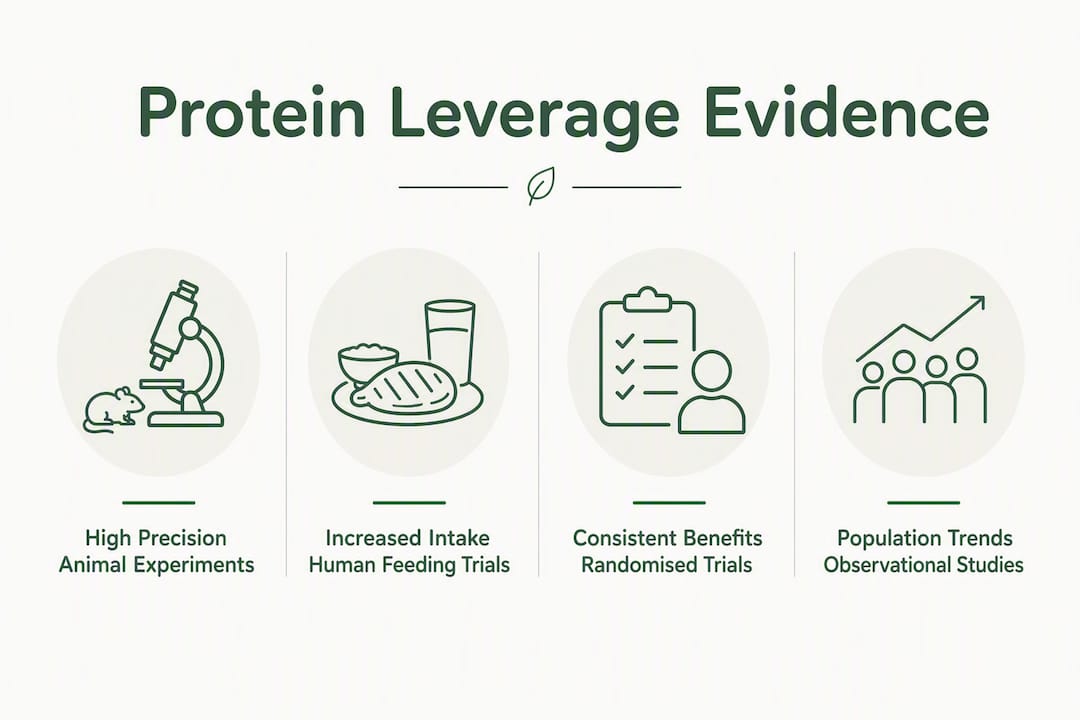
The evidence base for PLH spans four study types, each with different strengths and limitations.
Animal and laboratory experiments
Studies in insects, rodents, and primates consistently show that animals regulate protein intake with precision and will overeat non-protein energy when protein is diluted in the diet. These findings established the biological plausibility of the hypothesis and provided the initial framework for nutritional geometry. The consistency across species is striking, though the translation to free-living humans involves considerably more complexity.
Controlled human feeding trials
Acute feeding studies in humans show that meals with a lower protein proportion tend to produce greater subsequent energy intake. A randomised 14-day trial found higher calorie intake on ultra-processed menus compared with whole-food menus, and the authors suggest protein leverage may account for part of the effect, given that ultra-processed diets are typically protein-dilute. These controlled conditions remove many confounders but cannot replicate the complexity of real eating environments.
Randomised trials and longer interventions
Longer randomised trials examining higher-protein diets for weight management show consistent benefits for satiety, fat mass reduction, and lean mass preservation. Several clinical trials of 6–12 months found that high-protein diets reduce body weight and enhance body composition by decreasing fat mass while preserving fat-free mass, in both calorie-restricted and standard-calorie conditions. These trials do not always test PLH directly, but their outcomes are consistent with the hypothesis’s predictions.
Population and observational studies
Population analyses show that dietary protein proportion declines with greater ultra-processed food intake, and that absolute energy intake increases on lower percentage protein diets, consistent with PLH predictions. These associations are meaningful at scale but cannot establish causation on their own.
| Study type | Evidence strength | Typical finding | Key limitation |
|---|---|---|---|
| Animal experiments | High internal validity | Robust protein regulation; overeat on protein-dilute diets | Limited direct translation to humans |
| Acute human feeding trials | Moderate | Lower protein proportion increases subsequent intake | Short duration; controlled settings |
| Randomised trials (6–12 months) | Moderate–high | Higher protein reduces fat mass, preserves lean mass | Rarely test PLH mechanism directly |
| Population/observational studies | Moderate (association only) | UPF intake correlates with lower protein % and higher energy intake | Confounding; dietary recall error |
The convergence across study types is the strongest argument for taking PLH seriously. No single study type is definitive, but the direction of evidence is consistent.
Where does the evidence get complicated?
PLH is a well-supported hypothesis, not a settled law. Several genuine complications deserve attention.
Methodological limitations in the evidence base:
- Dietary recall and food frequency questionnaires, the most common measurement tools in population studies, introduce substantial error in estimating protein proportion.
- Most controlled trials are short (days to weeks), making it difficult to assess whether protein leverage operates the same way over months or years of free-living eating.
- Separating the effect of protein dilution from the effects of energy density, palatability, and fibre content in ultra-processed foods is methodologically difficult; these variables are correlated in real diets.
- Generalising from highly controlled lab settings to diverse free-living populations with different food cultures, incomes, and cooking habits is not straightforward.
Contradictory and mixed findings:
Some studies find that individuals vary considerably in how strongly they regulate protein intake. People with obesity, for instance, may show weaker protein-specific appetite regulation than lean individuals, which complicates the hypothesis’s universal application. A minority of studies find no significant increase in energy intake when protein proportion is reduced, particularly in short-term trials where participants are aware of the dietary manipulation.
Individual variability in food selection behaviour is also a genuine challenge. Not everyone compensates for low protein by eating more; some people simply tolerate a protein shortfall without increasing intake. This suggests that PLH describes a population-level tendency rather than a universal individual mechanism.
How to weigh the evidence:
Single studies, particularly short acute trials, should not be treated as definitive. Systematic reviews and meta-analyses that pool data across multiple trials give a more reliable picture. The current weight of evidence supports protein proportion as a meaningful driver of energy intake in many people, but the effect size varies, and protein leverage is one factor among several in a complex system.
What protein targets does the evidence support?
Daily targets by group
Clinical reviews and meta-analyses recommend approximately 1.2–1.6 g of protein per kilogram of body weight per day for weight management, with higher ranges for those who are highly active or in an energy deficit. The UK SACN reference nutrient intake for protein is 0.75 g/kg/day for sedentary adults, which represents a minimum for nitrogen balance rather than an optimal intake for satiety or body composition.
| Group | Recommended daily protein |
|---|---|
| Sedentary adults (maintenance) | 0.75–1.0 g/kg/day (UK SACN minimum to moderate) |
| Adults managing weight | 1.2–1.6 g/kg/day |
| Older adults (65+) | 1.2–1.6 g/kg/day (to offset anabolic resistance) |
| Active adults and athletes | 1.2–1.6 g/kg/day |
Per-meal targets and UK food examples
Distributing protein evenly across meals, targeting roughly 25–30 g per meal, is more effective for satiety and muscle maintenance than concentrating intake. For UK diets, that translates to practical portions:
- 120 g cooked chicken breast: approximately 30 g protein
- 2 large eggs plus 100 g cottage cheese: approximately 22 g protein
- 150 g tinned salmon: approximately 30 g protein
- 200 g cooked lentils: approximately 18 g protein (combine with a grain or dairy to improve amino acid completeness)
- 200 g plain Greek yoghurt: approximately 20 g protein
Aim for meals containing 25–30 g of protein for optimal satiety and muscle maintenance.
Protein quality and bioavailability
Animal proteins (meat, fish, eggs, dairy) are generally more bioavailable and contain all indispensable amino acids in adequate proportions. Plant proteins vary: soy and quinoa are complete; legumes are typically low in methionine; grains are low in lysine. Combining legumes with grains across the day (not necessarily within a single meal) covers the full amino acid spectrum. For people following plant-based diets, hitting 25–30 g of protein per meal requires deliberate planning, since plant foods tend to be more protein-dilute by calorie.
Avoiding protein dilution: practical rules
Do:
- Build every meal around a protein source before adding carbohydrates and fats.
- Choose higher-protein breakfast options (eggs, Greek yoghurt, smoked salmon) rather than cereal or toast alone.
- Add a protein component to snacks (a boiled egg, a small pot of cottage cheese, edamame).
Avoid:
- Ultra-processed savoury snacks as a primary between-meal option; they are almost always protein-dilute.
- Skipping protein at breakfast and then trying to compensate at dinner; the appetite regulation benefit is lost.
- Treating protein supplements as a substitute for whole-food protein sources without considering overall diet quality, fibre, and micronutrients.
Expert guidance emphasises that the goal is to correct protein dilution and improve dietary quality overall, not to endorse extreme protein intakes. Fibre, whole foods, and a varied diet remain central.
How to apply protein leverage principles day to day in the UK
A sample day with protein targets
Breakfast (target: 25–30 g protein) Two scrambled eggs with smoked salmon (approximately 30 g protein) on one slice of rye bread. Alternatively, 200 g plain Greek yoghurt with berries and a tablespoon of hemp seeds (approximately 22 g protein).

Mid-morning snack (target: 10–15 g protein) A small pot of cottage cheese (100 g) with cucumber slices, or a boiled egg with a small apple.
Lunch (target: 25–30 g protein) A large salad with 120 g tinned tuna or salmon, mixed leaves, cherry tomatoes, and olive oil dressing. Or a lentil and vegetable soup with a 100 g portion of halloumi on the side.
Afternoon snack (target: 10–15 g protein) 150 g plain Greek yoghurt, or 30 g mixed nuts with a boiled egg. Consistent protein at this point in the day is one of the most effective ways to avoid the mid-afternoon energy dip that often drives reaching for biscuits or crisps.
Dinner (target: 25–30 g protein) 150 g grilled salmon with roasted vegetables and a portion of quinoa (approximately 35 g protein). Or a chickpea and spinach curry with 200 g of tofu (approximately 25 g protein combined).
Shopping swaps to reduce protein dilution
- Replace standard breakfast cereal with Greek yoghurt or eggs; most cereals provide fewer than 5 g of protein per serving.
- Swap crisps and cereal bars for cottage cheese pots, edamame, or a small tin of sardines.
- Choose higher-protein bread options (seeded wholegrain, or protein-enriched varieties) over white bread.
- Stock tinned fish, tinned legumes, and eggs as default convenience proteins; they require no preparation and are widely available in UK supermarkets.
- When buying ready meals, check the protein content per serving; aim for at least 20 g per main meal portion.
Eating out in UK cafés, pubs, and takeaways
- In cafés, order eggs on toast rather than pastries; ask for an extra portion of smoked salmon if available.
- In pubs, grilled fish or chicken dishes are typically higher in protein than pies, burgers, or pasta; ask for extra vegetables instead of chips to reduce energy density.
- At Indian or Thai takeaways, choose lentil dhal, chicken tikka, or tofu dishes over naan-heavy or rice-heavy combinations; add a side of raita (yoghurt-based) for an extra protein contribution.
- For sandwiches, double the protein filling (egg, tuna, chicken) and reduce or remove one slice of bread to shift the protein proportion upward without dramatically changing the meal.
Who needs to be cautious with higher protein intakes?
Protein leverage principles are broadly applicable, but certain groups need to approach higher protein intakes with care and, in some cases, medical supervision.
Kidney disease: People with chronic kidney disease (CKD) at stage 3 or above should not increase protein intake without guidance from a nephrologist or renal dietitian. Higher protein loads increase the filtration burden on already-compromised kidneys. The NHS recommends that people with CKD follow a protein intake tailored to their specific stage and eGFR, which may be lower than general population recommendations.
Pregnancy: Protein needs increase during pregnancy, but the distribution and sources matter. Pregnant people should follow NHS guidance on safe food choices (avoiding raw fish, unpasteurised dairy, and high-mercury fish) and discuss any significant dietary changes with their midwife or GP.
Older adults: Adults over 65 tend to experience anabolic resistance, meaning they require more protein per meal to stimulate the same muscle protein synthesis response as younger adults. A target of 1.2–1.6 g/kg/day, with approximately 25–30 g per meal, is supported by current evidence for this group. Protein intake for muscle building and maintenance is particularly relevant for older adults seeking to preserve lean mass.
Children and adolescents: Protein needs are proportionally higher during growth phases, but children should not follow adult weight-management protein targets. Dietary changes for children should be guided by a paediatric dietitian or GP.
When to seek clinical advice:
- CKD stage 3 or above, or any diagnosed kidney condition
- Pregnancy, particularly with complications such as gestational diabetes or pre-eclampsia
- A history of eating disorders, where a protein-focused approach may require careful framing
- Liver disease, where protein metabolism is altered
- Any chronic condition managed with medication that affects nutrient absorption or metabolism
UK residents can access NHS dietitian referrals through their GP, or consult a registered nutritional therapist for personalised guidance. The British Dietetic Association (BDA) maintains a directory of registered dietitians for private referrals.
For people with metabolic conditions such as insulin resistance, protein distribution across the day also affects blood glucose regulation, adding another reason to seek personalised rather than generic advice.
How personalised programmes translate protein leverage into practice
Understanding PLH is one thing; applying it consistently within the constraints of a real life, with a real food environment, real preferences, and real competing demands, is another. This is where a structured programme makes a measurable difference.
A well-designed personalised nutrition programme applies PLH through several practical steps:
- Baseline assessment: mapping current protein intake, meal timing, and the proportion of ultra-processed foods in the diet to identify where protein dilution is occurring.
- Personalised targets: setting protein targets in g/kg/day and g/meal based on the individual’s body weight, activity level, health status, and goals, rather than applying a generic figure.
- Meal planning support: building meal templates that hit the 25–30 g per meal target using foods the client actually eats and can access in their local area.
- Monitoring and adjustment: tracking appetite, energy, and body composition over weeks rather than days, since PLH effects on appetite regulation take time to stabilise.
- Optional laboratory testing: functional tests (such as amino acid profiles or metabolic panels) can identify specific nutritional gaps that are not visible from dietary recall alone.
Consider a client who comes in reporting persistent afternoon hunger and difficulty maintaining weight loss despite eating what they consider a “healthy” diet. A detailed dietary analysis reveals that their breakfast is protein-poor (toast and jam, approximately 4 g protein), their lunch is moderate (a sandwich with chicken, approximately 18 g protein), and their dinner is protein-adequate (approximately 30 g protein). Total daily protein is sufficient in absolute terms, but the distribution is skewed heavily toward the evening. Shifting protein earlier in the day, adding a protein-rich mid-morning snack, and replacing the afternoon biscuits with a cottage cheese pot, produces a noticeable reduction in afternoon hunger within two to three weeks, without any change in total daily calories.
Clinical evidence consistently shows that adherence is the main determinant of benefit in higher-protein dietary interventions. Personalised programmes that address habits, food environment, and monitoring achieve better long-term results than one-off advice, because they account for the specific barriers each person faces.
Pro Tip: When reviewing your own diet, look for “protein decoys”: ultra-processed, savoury foods that feel substantial but contribute fewer than 5 g of protein per serving. Replacing even one or two of these per day with a modest whole-food protein source can shift your protein proportion meaningfully without overhauling your entire diet.
Key takeaways
The protein leverage hypothesis offers a coherent, evidence-supported explanation for why protein proportion in the diet, not just total calories, drives appetite and energy intake, with direct implications for weight management and food choices.
| Point | Details |
|---|---|
| The PLH core claim | When dietary protein is diluted, total calorie intake rises as the body seeks to meet its protein target. |
| Evidence strength | Consistent across animal studies, controlled trials, and population data; effect size varies between individuals. |
| Practical protein targets | Aim for 1.2–1.6 g/kg/day for weight management and roughly 25–30 g of protein per meal, distributed evenly across the day. |
| Reduce protein dilution | Replace ultra-processed snacks with whole-food protein sources; build every meal around a protein anchor. |
| Foodconnection’s approach | Foodconnection’s personalised programmes apply PLH through individual assessment, tailored targets, and ongoing support to improve adherence and outcomes. |
If you have a kidney condition, are pregnant, or manage a chronic health condition, discuss any significant change to protein intake with your GP or a registered dietitian before making adjustments.
Why protein proportion matters more than most people realise
The most common misreading of protein leverage is treating it as a justification for extreme high-protein diets. It is not. The hypothesis says nothing about eating as much protein as possible; it says that falling below your body’s protein target causes compensatory overeating. The intervention is correcting a deficit, not creating a surplus.
What strikes me most about the PLH evidence is how well it explains something clinicians observe routinely: people who eat what looks like a reasonable calorie intake still gain weight, because the calorie count obscures the macronutrient composition. A diet of 2,000 kcal that is 12% protein will drive different eating behaviour than a diet of 2,000 kcal that is 18% protein, even though the calorie total is identical. That distinction rarely appears in standard dietary advice, which still tends to focus on calorie totals and portion sizes.
The practical implication is also more nuanced than “eat more protein.” The real target is reducing protein dilution, which means paying attention to the protein proportion of every meal and snack, not just adding a protein shake at the end of the day. Fibre, food quality, and meal distribution all interact with protein leverage in ways that a simple calorie-counting approach misses entirely. Getting this right, particularly for people with complex health histories, is precisely where a structured, personalised programme adds value that generic advice cannot.
Foodconnection’s personalised weight management programmes

If the evidence for protein leverage has you thinking about your own diet, the gap between understanding the theory and applying it consistently is where most people get stuck. Foodconnection’s personalised weight management programmes are built specifically for this: not a one-off consultation with a generic meal plan, but a structured programme with ongoing support, regular check-ins, and the option to add functional laboratory testing where it adds diagnostic value.
The programme starts with a detailed assessment of your current diet, lifestyle, and health history, then sets protein targets and meal frameworks tailored to your body weight, activity level, and food preferences. Support continues throughout, adjusting targets as your body composition and appetite patterns change. For readers with complex health needs, such as hormonal imbalances, chronic fatigue, or metabolic conditions, the programme integrates those factors rather than treating weight management in isolation.
To find out whether a personalised programme is the right fit, visit Foodconnection’s services page or book an initial consultation. If you have a diagnosed medical condition, please discuss dietary changes with your GP first.
Useful sources for further reading
The sources below represent the primary evidence base for this article, ranging from foundational reviews to clinical trials and UK guidance.
| Source | Type | What it covers |
|---|---|---|
| Raubenheimer & Simpson, Royal Society (2022) | Review | Core PLH synthesis: nutritional geometry, mechanisms, and multi-study evidence |
| Protein appetite as an integrator in obesity — PMC | Review | Population-level evidence linking UPF intake, protein dilution, and energy intake |
| Clinical evidence for high-protein diets — PMC | Clinical review | 6–12 month trial data on body weight and composition outcomes |
| Protein in weight loss and maintenance — ScienceDirect | Clinical review | Numeric targets, adherence evidence, and satiety mechanisms |
| Protein timing and distribution — JISSN | Review | Per-meal distribution evidence and muscle maintenance implications |
| NASM protein targets for weight loss | Practitioner guidance | Per-meal and per-day targets for active adults and weight loss phases |
| NHS — protein and diet | UK primary guidance | UK reference intakes and food safety guidance |
- Reviews — (Royal Society, PMC) synthesise evidence across multiple study types and are the strongest source for understanding the overall direction of evidence.
Recommended
- Insulin resistance diet: why personalisation changes everything | FoodConnection blog
- Prediabetes diet: managing blood sugar with complex health needs | FoodConnection blog
- Is it worth paying for a nutritionist or nutritional therapist? | FoodConnection blog
- How to Choose the Right Nutritionist in London (And Avoid Costly Mistakes) | FoodConnection blog