
Personalised nutrition plan: your complete UK guide

A personalised nutrition plan is a tailored eating and lifestyle blueprint built from your unique biology, health history, and goals. It is not a generic calorie target or a meal-prep template downloaded from a wellness app. The inputs that define it include biometrics (weight, height, body composition), current medications, presenting symptoms, dietary history, activity levels, sleep patterns, and, where clinically indicated, blood tests or gut microbiome analysis.
The immediate next step depends on where you are starting from:
- Gather a short baseline: keep a 3-day food log (two weekdays and one weekend day), note all current medications and supplements, and record at least one biometric (weight or waist circumference).
- Identify your complexity level: clear-cut goals with no medical history? A structured DIY approach or a digital programme may be enough. Digestive disorders, hormonal imbalances, thyroid conditions, or multiple medications? Book an initial consultation with a qualified practitioner before building anything.
- Decide on testing: if your GP has run blood tests in the past 12 months, gather those results. If not, a practitioner can advise whether targeted functional testing adds value for your specific situation.
Table of Contents
- What does a personalised nutrition plan actually include?
- Does personalised nutrition actually work?
- How a personalised nutrition plan is created, step by step
- Who benefits most, and when should you see a practitioner?
- What does a personalised nutrition plan cost in the UK?
- Which type of personalised nutrition service suits you?
- How to choose a qualified UK nutrition provider
- How Foodconnection builds personalised nutrition plans
- Key takeaways
- Why the “set it and forget it” plan almost never works
- Foodconnection’s personalised nutrition programmes
- Useful sources and further reading
What does a personalised nutrition plan actually include?
The word “personalised” covers a wide spectrum, from a macro calculator that adjusts for your weight to a clinician-led protocol informed by stool analysis and hormone panels. Understanding where on that spectrum your plan sits matters, because the evidence behind each level differs.
The main data inputs and what they change:
- Diet history and food preferences: identifies patterns (skipped meals, low protein, ultra-processed food reliance) and shapes food choices that the person will actually follow.
- Activity and sleep: determines energy requirements and recovery nutrition; poor sleep independently affects hunger hormones, so a plan that ignores it will miss a key lever.
- Medical history and medications: some medications deplete specific nutrients (metformin and B12, for example); others interact with dietary components (grapefruit and statins). A plan built without this information can be actively unhelpful.
- Blood tests: fasting glucose, HbA1c, full blood count, thyroid function, ferritin, and vitamin D are the most commonly relevant markers. They shift targets meaningfully: someone with low ferritin needs a different iron strategy than someone with normal levels.
- Body composition: weight alone is a poor proxy. Body fat percentage and lean mass alter protein targets and calorie distribution significantly.
- Symptoms: bloating, fatigue, brain fog, and irregular cycles are data points. A symptom timeline mapped against food and lifestyle often reveals patterns a food log alone would miss.
- Gut testing: stool analysis (such as the GI-MAP or Genova Diagnostics panels) can identify dysbiosis, parasites, or inflammation markers that explain persistent digestive symptoms. Not every client needs this, but for complex IBS or IBD presentations it changes the plan substantially.
- Genetics: nutrigenomics is a growing field, but its clinical utility is currently limited for most people. Genetic variants in MTHFR (folate metabolism) or APOE (fat metabolism) can inform specific recommendations, though genetics alone rarely overrides lifestyle factors.
Three levels of personalisation:
- Basic: macro and calorie targets adjusted for your weight, activity, and goal. Useful for straightforward fat loss or muscle gain with no medical complexity.
- Clinical: lab-driven and therapeutic, built around a diagnosed condition (insulin resistance, PCOS, hypothyroidism). Requires practitioner oversight. For a practical example of how this works with insulin resistance, the dietary strategy shifts considerably once fasting insulin and glucose data are in hand.
- Precision: integrates genetics, microbiome data, and continuous glucose monitoring. The most data-rich approach, though also the most expensive and, for most people, not yet necessary.
Does personalised nutrition actually work?
The short answer: yes, with important caveats about what “personalised” means and which conditions benefit most.
The strongest evidence comes from metabolic health. A landmark study published in Cell by Zeevi et al. demonstrated that postprandial glucose responses to identical foods vary dramatically between individuals, and that personalised dietary advice based on microbiome and glycaemic data outperformed standard dietary guidelines for blood sugar control. The Weizmann Institute’s follow-up work reinforced that gut microbiome composition is a meaningful predictor of individual food responses, not just an interesting footnote.

For clinically supervised weight management, a flexible personalised meal planning approach has shown better adherence and outcomes than rigid prescriptive diets, particularly when plans account for food preferences and eating patterns rather than imposing a uniform template.
Where the evidence is weaker or more mixed: genetics-only approaches (without metabolic or microbiome data) show modest effect sizes for most people; algorithm-driven apps without clinician oversight tend to underperform for complex conditions; and short-term interventions without reassessment rarely produce lasting change.
Practical limitations to be honest about:
- Some inputs, particularly raw genetic data, are easy to over-interpret. Precision inputs such as bloodwork and DEXA add real value when an evidence-trained clinician links markers to practical dietary changes. Without that interpretation, raw numbers can mislead.
- Data privacy is a genuine concern. Apps that collect detailed health data, including microbiome results and continuous glucose readings, are subject to GDPR in the UK, but enforcement varies and data-sharing practices differ widely between providers.
- Cost creates access barriers. The most evidence-backed approaches (clinician-led, lab-informed) are not cheap, and NHS dietetic referrals, while free, often have long waiting lists and limited session frequency.
- Algorithms overpromise. Many commercial platforms use “personalised” as a marketing term for what is essentially a macro calculator with a food preference filter.
How a personalised nutrition plan is created, step by step
A well-structured programme follows a clear sequence. Here is what to expect, whether you are working with a practitioner or building a plan yourself.
1. Intake questionnaire (30–60 minutes) A thorough intake covers medical history, current medications and supplements, digestive function, menstrual cycle (where relevant), sleep, stress, activity, and food preferences. These inputs comprehensively shape every subsequent recommendation.
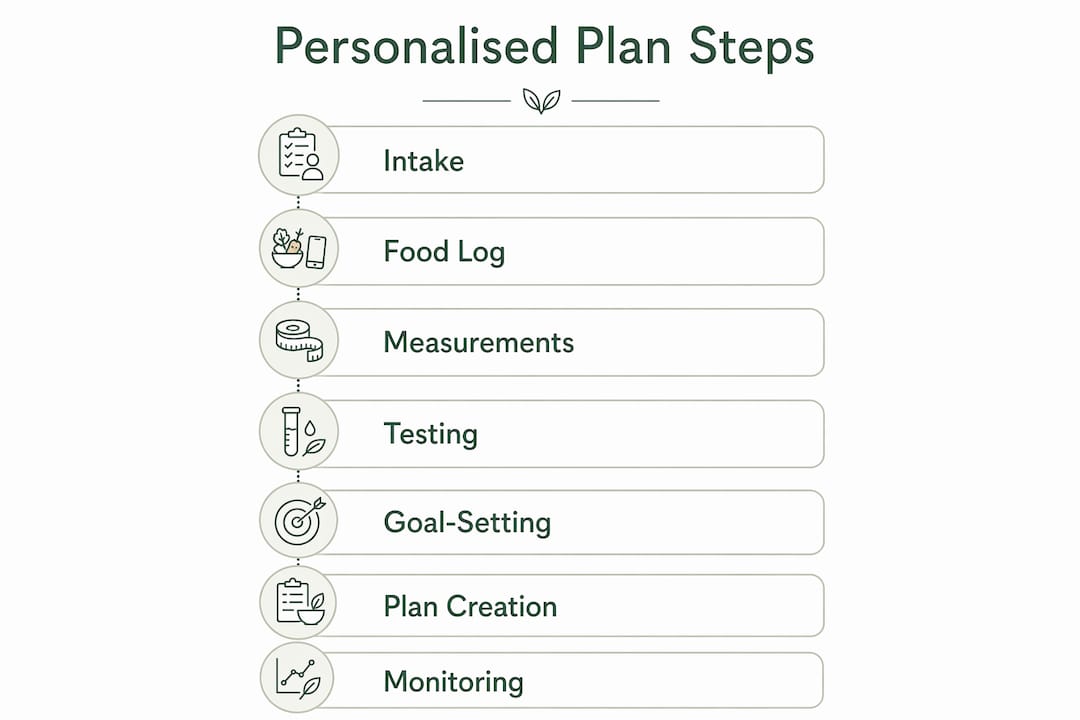
2. Three-day food log Two weekdays and one weekend day, recorded in real time (not from memory). Include portion sizes, timings, drinks, and how you felt after eating. This single step reveals more about eating patterns than most people expect.
3. Baseline measurements Weight, height, waist circumference, and, where possible, body composition. If you have recent blood test results from your GP, gather those now.
4. Targeted testing (only where indicated) Not every client needs functional lab tests. A practitioner will recommend specific panels based on symptoms and history. Common examples include a full thyroid panel (TSH, T3, T4), hormone profiles (oestrogen, progesterone, testosterone, DHEA), or a comprehensive stool analysis for digestive concerns. Ordering tests without clinical reasoning behind them wastes money and can generate anxiety about incidental findings.
5. Goal-setting Goals should be specific, measurable, and time-bound. “Lose weight” is not a goal; “reduce body fat by 5% over 12 weeks while maintaining energy for work and exercise” is. Behaviour-change goals (cook four evenings a week, eat breakfast daily) sit alongside outcome goals.
6. Plan creation and delivery A clinical-grade plan typically takes several working days to produce after all data is gathered. It includes daily meal structures, portion guidance, snack options, supplement recommendations where indicated, and a behaviour-change strategy.
7. Onboarding and monitoring cadence The first plan is a baseline, not a final answer. Practitioners recommend an early feedback cycle within the first few weeks to catch anything that is not working before it becomes a habit, followed by a structured reassessment after a sufficient period for habits to form.
Sample week structure (clinical programme):
| Day type | Breakfast | Lunch | Dinner | Snack strategy |
|---|---|---|---|---|
| Weekday | Protein + fibre base (e.g. eggs, oats, Greek yoghurt) | Balanced plate: protein, complex carb, vegetables | Protein + vegetables + healthy fat | One planned snack if needed; timed to blood sugar patterns |
| Weekend | Flexible but structured; same macronutrient targets | Larger social meal accommodated within weekly targets | Lighter if lunch was larger | No unplanned grazing |

Pro Tip: When keeping your 3-day food log, photograph every meal before eating it. Photos capture portion sizes far more accurately than written estimates, and they take ten seconds. Pair each photo with a brief note on hunger level (1–10) and energy 90 minutes after eating.
Adaptive platforms such as Nutriora recalibrate plans weekly based on progress data and user feedback, which helps prevent the plateaus that derail static plans. The principle is sound regardless of the tool: a plan that does not change in response to your data is not truly personalised.
Who benefits most, and when should you see a practitioner?
A personalised eating plan adds clear value for almost anyone, but the level of support needed varies considerably.
Clinical indications that require practitioner input:
- Diagnosed digestive disorders (IBS, IBD, SIBO, coeliac disease). Dietary manipulation without clinical oversight can worsen symptoms. If persistent bloating is your main concern, a gut health nutritionist can map symptoms to dietary triggers systematically.
- Hormonal imbalances: PCOS, endometriosis, perimenopause, menopause, thyroid disorders. These conditions alter nutrient requirements and interact with dietary patterns in ways that a generic plan will not capture.
- Significant unintentional weight change (gain or loss) without a clear cause.
- Complex multimorbidity: managing two or more chronic conditions simultaneously, particularly when each has its own dietary implications.
- Multiple medications, especially where nutrient interactions or timing considerations apply.
- Chronic fatigue or suspected nutrient deficiencies not yet investigated.
Who can start with a structured DIY plan:
Adults with clear-cut goals (body composition change, performance nutrition, general healthy eating habits), no diagnosed medical conditions, and no current medications can reasonably begin with a structured self-directed approach. Use validated tools to estimate calorie needs, set protein targets based on body weight and activity, and build meals around whole foods. Reassess after 4–6 weeks.
Red flags that mean see a clinician now, not later:
- Unexplained weight loss of more than 5% of body weight over 6–12 months
- Severe or worsening gastrointestinal symptoms (blood in stool, persistent pain, significant changes in bowel habit)
- Dietary changes that coincide with a medication change or new diagnosis
- Any history of, or current concerns about, disordered eating
- Symptoms that suggest a serious underlying condition (extreme fatigue, hair loss, palpitations, significant mood changes)
What does a personalised nutrition plan cost in the UK?
Costs vary considerably depending on the depth of assessment, whether lab testing is included, practitioner credentials, and the length of ongoing support.
| Service type | Typical UK price range | What is included |
|---|---|---|
| One-off bespoke plan (clinician-led) | £475 | Consultation, food diary analysis, written plan |
| Short programme (up to 12 weeks) | — | Plan + 2–4 check-ins, monitoring |
| Ongoing coaching (monthly) | — | Regular reviews, plan adjustments |
| Functional lab tests (add-on) | — | Stool, hormone, thyroid, or SIBO panels |
| App-based plans | — | Algorithm-driven; limited clinical oversight |
As a reference point, a bespoke clinician package from a UK sports nutritionist is priced at £475, covering a consultation, three-day food diary analysis, and a 12-week journalling system. This is a typical market rate for a one-off clinical plan.
Realistic timelines:
Early changes in energy, digestion, and mood are often noticeable within a few weeks, particularly when the plan addresses an obvious dietary gap (low protein, inadequate fibre, skipped meals). Measurable shifts in body composition, blood markers, or symptom scores generally require consistent adherence over several weeks. Reassessment after a few months is the standard clinical checkpoint: it is long enough to see genuine trends and short enough to course-correct before habits calcify.
What drives cost upward: deeper initial assessment, functional lab testing with interpretation, more frequent check-ins, and practitioner seniority. Registered dietitians (RDs) and registered nutritional therapists with BANT membership or CNHC registration tend to charge more than unregulated practitioners, and for good reason.
Which type of personalised nutrition service suits you?
| Service model | How it works | Best for | Limitations |
|---|---|---|---|
| Algorithm/app-driven | Questionnaire + macro calculator; some use AI to adjust weekly | Simple goals, healthy adults, low budget | Poor at complex conditions; no clinical interpretation |
| Clinician-delivered (RD or nutritional therapist) | One-to-one assessment, lab review, bespoke plan | Complex conditions, medical history, hormonal issues | Higher cost; waiting times vary |
| Hybrid (app + clinician review) | App handles routine tracking; clinician reviews biomarkers and flags issues | Moderate complexity; wants speed and clinical safety | Quality varies; check clinician credentials carefully |
| Lab-led protocol | Functional testing drives the plan; clinician interprets results | Unexplained symptoms, gut issues, hormonal imbalances | Most expensive; not always necessary |
A note on credentials in the UK:
The term “nutritionist” is not legally protected in the UK. Anyone can use it. Registered Dietitians (RDs) are regulated by the Health and Care Professions Council (HCPC) and hold the highest protected status. Registered Nutritionists (RNutr) are accredited by the Association for Nutrition (AfN). Nutritional therapists registered with BANT (British Association for Nutrition and Lifestyle Medicine) and CNHC (Complementary and Natural Healthcare Council) operate within a professional framework with ethical standards and CPD requirements. When choosing a provider, these registrations matter.
Clinician-reviewed hybrid services balance speed and accuracy well for moderate-complexity cases. Apps handle routine adjustments while clinicians interpret the biomarker patterns or symptom clusters that algorithms consistently miss.
How to choose a qualified UK nutrition provider
A short checklist before you book anything:
- Verify registration: check HCPC for dietitians, AfN for registered nutritionists, BANT and CNHC for nutritional therapists. A practitioner who cannot point you to their registration number is a red flag.
- Confirm relevant experience: ask specifically about their experience with your condition or goal. “I work with digestive issues” is vague; “I have worked with IBS and SIBO clients for five years and use GI-MAP testing” is specific.
- Ask about their testing approach: which labs do they use? How are results interpreted? Are tests recommended based on your individual presentation, or does everyone get the same panel?
- Understand the monitoring plan: how often will you check in? How is the plan revised? A practitioner who hands you a plan and disappears for three months is not offering a programme; they are offering a document.
- Check data privacy: how is your health data stored? Is it shared with third parties? GDPR applies, but ask explicitly.
- Get pricing in writing: full costs, including any add-on tests, before you commit.
Questions to ask on a discovery call:
- How do you measure outcomes, and what does success look like for someone with my goals?
- What happens if the plan is not working after four weeks?
- Do you communicate with my GP or other treating clinicians if needed?
- What is your approach to supplements: do you recommend them routinely, or only where there is a clinical indication?
Red flags to walk away from:
- Guarantees of rapid weight loss (more than 0.5–1 kg per week is rarely sustainable or safe)
- A blanket supplement protocol recommended before any assessment
- Opaque pricing with hidden test costs revealed after sign-up
- No mention of reassessment or monitoring
- Pressure to commit to a long programme before a discovery call
For more practical guidance on choosing a nutritionist in the UK, including the specific questions that separate good practitioners from poor ones, Foodconnection’s blog covers the process in detail.
How Foodconnection builds personalised nutrition plans
Foodconnection’s approach is a useful worked example of what a clinician-led programme looks like in practice. The process begins with a thorough one-to-one consultation covering medical history, symptoms, medications, diet, lifestyle, and goals. No two clients receive the same plan, because no two clients present with the same combination of inputs.
Where functional testing adds clinical value, Foodconnection offers laboratory testing options covering digestive health, hormonal panels, thyroid function, and SIBO, with full interpretation included. Tests are recommended based on individual presentation, not as a default upsell. This distinction matters: ordering a comprehensive stool analysis for someone with no digestive symptoms is unnecessary; ordering one for a client with three years of unexplained bloating and fatigue is clinically justified.
The programme model means clients are not left with a static document. Plans are reviewed and adjusted as data comes in, with early check-ins in the first 1–2 weeks and a structured reassessment at 12 weeks. Complementary support, including yoga and lifestyle guidance, is available for clients whose stress or sleep patterns are materially affecting their nutritional outcomes.
Foodconnection works with clients managing digestive disorders, hormonal imbalances, weight management, thyroid conditions, chronic fatigue, menopause, and healthy ageing. Consultations are available in London and online. When integrating a personalised nutrition programme with existing medical treatment, Foodconnection maintains clear communication with prescribing clinicians and ensures that any lab-test selection is transparent and clinically justified, particularly where medication interactions (such as timing considerations with GLP-1 medications and protein intake) are relevant.
Key takeaways
A personalised nutrition plan works when it is built from real individual data, reviewed regularly, and adjusted based on what the evidence actually shows, not what a generic template assumes.
| Point | Details |
|---|---|
| Personalisation requires real inputs | A plan built only on weight and calorie targets is not truly personalised; blood markers, symptoms, and lifestyle data change recommendations meaningfully. |
| Evidence is strongest for metabolic health | Clinically supervised plans for insulin resistance, blood sugar control, and weight management show the clearest benefits over generic dietary advice. |
| Reassessment at 12 weeks is standard | A single plan without review rarely produces lasting change; structured check-ins and a 12-week reassessment are the clinical norm. |
| Credentials matter in the UK | Check HCPC (dietitians), AfN (registered nutritionists), or BANT/CNHC (nutritional therapists) before booking any provider. |
| Foodconnection offers clinician-led programmes | One-to-one support, optional functional lab testing, and ongoing review for digestive, hormonal, weight, and fatigue concerns, available in London and online. |
Why the “set it and forget it” plan almost never works
Most people who try a personalised diet plan and abandon it within six weeks do not fail because they lack willpower; they fail because the plan was treated as a finished product rather than a starting point.
The iterative nature of effective nutrition support is genuinely underappreciated. A client who comes in with chronic fatigue and suspected hormonal imbalance does not need a perfect plan on day one. They need a reasonable first hypothesis, a clear monitoring structure, and a practitioner who will look at what is actually happening at week two and adjust accordingly. The initial plan reveals what the questionnaire and food log could not: how the person actually eats under real-life conditions, which recommendations they find sustainable, and where the gaps between intention and behaviour sit.
What I see consistently is that the clients who make the most durable changes are not the ones who follow a plan perfectly. They are the ones who stay in the process long enough for the plan to evolve around their real life. That usually takes at least 12 weeks. The initial period focuses as much on data collection as it does on intervention.
Behaviour change support is not a soft add-on to a nutrition programme. It is the mechanism by which dietary knowledge becomes dietary habit. Without it, even a technically excellent bespoke plan tends to gather dust after the initial motivation fades.
Foodconnection’s personalised nutrition programmes
If you have read this far and recognised yourself in the clinical indications section, or if you have tried generic plans before and found them inadequate for your specific situation, a structured programme with proper clinical oversight is worth considering seriously.
Foodconnection offers one-to-one personalised nutrition programmes for adults managing digestive disorders, hormonal imbalances, weight concerns, thyroid conditions, chronic fatigue, and menopause. Each programme begins with a thorough consultation, includes a bespoke plan built around your biology and lifestyle, and provides ongoing support with structured reassessment. Optional functional laboratory testing is available for clients where targeted investigation adds clinical value, with full interpretation included in the programme.
For readers specifically focused on weight management, Foodconnection’s personalised weight loss programmes combine dietary strategy with behaviour-change support and monitoring, rather than handing over a calorie target and leaving you to it.
To book an initial consultation or find out which programme suits your situation, visit Foodconnection and get in touch directly. The first step is a conversation, not a commitment.
This article is general information, not medical or clinical advice. For your own situation, particularly if you have a diagnosed condition or are taking medication, confirm recommendations with your GP or a qualified registered practitioner.
Useful sources and further reading
- Zeevi et al., Cell 2015: Personalised nutrition by prediction of glycaemic responses — the landmark randomised trial showing individual variation in blood sugar responses to identical foods; foundational reading for understanding why personalisation matters.
- PMC: Personalised flexible meal planning for individuals with diet-related conditions — peer-reviewed evidence on adherence and outcomes from flexible, personalised meal planning versus rigid dietary prescriptions.
- Weizmann Institute: gut microbiome and personalised nutrition — follow-up research on microbiome composition as a predictor of individual food responses.
- Foodconnection: insulin resistance diet and personalisation — practical explanation of how personalised dietary strategy changes for insulin resistance specifically.
- Foodconnection: is it worth paying for a nutritionist? — helps readers weigh the value of clinician-led plans against cheaper alternatives.
- Foodconnection: thinking of working with a nutritional therapist? — what to expect from the process and how to assess whether a practitioner is a good fit.
- Yakonow: reading nutrition labels for blood sugar management — practical consumer guide on label reading for people managing diabetes or blood sugar as part of a personalised plan.
- AARP personalised nutrition hub — patient-facing resource with condition-focused meal plans and practical guidance; useful for readers who want accessible, structured examples.
- Mayo Clinic Diet: personalised plan tool — evidence-based digital tool for building a structured eating plan; useful as a starting point for readers with straightforward goals.
Recommended
- FoodConnection — Personalised nutrition therapy in London & online
- How to Choose the Right Nutritionist in London (And Avoid Costly Mistakes) | FoodConnection blog
- Insulin resistance diet: why personalisation changes everything | FoodConnection blog
- Is it worth paying for a nutritionist or nutritional therapist? | FoodConnection blog