
12 Week Results: Does Ongoing Nutrition Support Pay Off for UK Adults?

Ongoing nutrition support is a paid, programme-based service that pairs an initial assessment with follow-up consultations, a tailored eating plan and, often, functional lab testing, delivered over several weeks rather than a single visit. It typically suits adults with chronic or complex issues such as digestive problems, hormonal imbalance or long-term weight management who want continuity and accountability. Before you pay for one, check the practitioner’s professional registration.
TL;DR:
- Ongoing nutrition programs typically include a 60 to 90-minute initial assessment, written personalized recommendations, measurable goals, and scheduled follow-ups over several weeks.
- The most effective support targets individuals with complex issues like digestive problems, hormonal imbalances, or persistent weight management challenges, requiring consistent client commitment.
- Evidence shows personalized guidance and frequent contact improve dietary habits and symptom control, with 82% of Food Connection clients reporting benefits.
- Verify practitioners’ qualifications using official registration in the UK, especially for dietitians, and avoid providers offering guarantees or promoting unsupported detox plans.
- A standard 12-week program usually involves an initial consultation, interpretation of lab results if available, and regular follow-ups to adapt the plan as progress occurs.
Table of Contents
- What a programme-based ongoing nutrition support package includes
- Who benefits most from ongoing support
- How ongoing support works in practice: the client journey
- Evidence and expected outcomes from programme-based personalised nutrition
- How to choose a credible ongoing nutrition programme and practitioner
- A practical 12-week timeline: what to expect in the first three months
- Food Connection’s approach to ongoing nutrition support
- Getting started with Food Connection’s nutrition programmes
- Sources
- FAQ
What a programme-based ongoing nutrition support package includes
A genuine programme looks nothing like a single generic diet sheet. It starts with a longer initial assessment, usually 60 to 90 minutes, covering medical history, current eating patterns, symptoms and lifestyle factors, and it is backed by a food diary completed before the appointment, which practitioners use as a diagnostic tool rather than a formality.
From there, a credible package includes:
- Written personalised recommendations rather than verbal advice you have to remember.
- Measurable goals tied to your specific symptoms or targets.
- A defined follow-up schedule, not an open-ended “get in touch when you need to”.
- Behaviour-change support, such as action plans or reminders, built into the process.
- Optional add-ons: functional lab tests, specialist referrals or complementary services like yoga.
The presence or absence of these deliverables is usually the clearest way to tell a structured programme from a one-off consultation dressed up as one. Personalised nutrition plans generally spell out each of these components before you commit.
Who benefits most from ongoing support
Programme-based nutrition support tends to suit people managing something more layered than “eat a bit better.” It is not the same thing as clinical inpatient nutrition support such as enteral or parenteral feeding, which is a different service delivered in hospital settings for patients who cannot eat normally: that is not what this article covers.
The people who tend to get the most from an ongoing programme include those dealing with:
- Digestive issues such as IBS, bloating or irregular bowel patterns.
- Hormonal imbalances, including thyroid conditions and menopause-related symptoms.
- Chronic fatigue that has not resolved with basic dietary tweaks.
- Long-term weight management where previous short-term diets have not stuck.
Success also depends on the client. Programmes ask for consistent food diary entries, honest reporting and attendance at follow-ups, so readiness to commit for several weeks matters as much as the plan itself.
How ongoing support works in practice: the client journey
The process is more structured than most people expect. It usually follows a consistent sequence, whether sessions happen in person or remotely.
- Pre-appointment: you complete a food diary and note baseline measures such as symptoms, energy levels or weight, which NHS dietetics services also treat as a critical diagnostic step before any plan is written.
- Initial consultation: over 60 to 90 minutes, the practitioner reviews your history, diary and any lab results, then agrees goals with you.
- Follow-up sessions: spaced across several weeks, these review progress, adjust the plan and reinforce habits using behaviour-change techniques such as action plans or prompted check-ins.
- Ongoing adjustment: the plan evolves as symptoms change or new test results come in, rather than staying fixed from week one.
Remote and face-to-face formats both follow this pattern, though remote programmes often allow more frequent, shorter check-ins between formal sessions, which can help with adherence.
Pro Tip: Keep your food diary in the same app or notebook for the whole programme so your practitioner can spot patterns across weeks, not just within one appointment.
Evidence and expected outcomes from programme-based personalised nutrition
The evidence for personalised nutrition is genuinely encouraging, with some caveats. Research built on the Food4Me trials found that personalised nutrition advice based on diet, phenotype and sometimes genotype improved dietary intake more than generic advice across multiple trials, and effects were larger when interventions included behaviour-change techniques.
Separate evidence looking across chronic disease programmes found that more frequent contact and specific behaviour-change techniques were associated with better outcomes in dietary behaviour change, though results for hard clinical endpoints remain mixed across reviews. Frequency of contact, not just the quality of the initial plan, appears to be a genuine driver of whether changes stick.
Clients report meaningful improvements in energy and symptom control after structured, ongoing support.
Food Connection’s own client feedback points in the same direction. The business reports that 82% of clients saw improvement through its coaching programmes, a figure drawn from internal testimonials rather than a published clinical trial, so it should be read as a self-reported outcome alongside the wider research base.
How to choose a credible ongoing nutrition programme and practitioner
Registration is the first filter. In the UK, “Dietitian” is a protected title regulated by the Health and Care Professions Council, so you can verify registration before booking anyone using that title. “Nutritionist” is not protected in the same way, which is worth understanding before you compare practitioners; this guide to dietitians versus nutritionists covers the distinction in more detail.
Before paying, ask:
- How long is the initial consultation, and will I receive written recommendations?
- How many follow-ups are included, and how are they spaced?
- Can lab test results be interpreted as part of the package?
- What happens if the plan is not working after a few weeks?
Watch for red flags too: promises of a “detox” or guaranteed cure, pressure to buy specific supplements, lab tests presented without proper interpretation, or a plan with no measurable goals attached to it.
Pro Tip: Ask to see a sample of the written recommendations format before you book, so you know exactly what you are paying for.
A practical 12-week timeline: what to expect in the first three months
Most structured programmes follow a similar shape across the first 12 weeks, even when the details differ.
- Weeks 0 to 2: paperwork, food diary completion, the initial consultation and agreement of baseline goals.
- Weeks 3 to 6: early adjustments to the plan, lab results (if ordered) come back and are interpreted, and adherence support begins in earnest.
- Weeks 7 to 12: habits start to consolidate, a second formal review takes place, and you and your practitioner decide whether to move to maintenance or extend structured support.
This phasing matches the cadence used in 12 weeks of dedicated support style packages, where the bulk of behaviour change tends to happen in the middle stretch rather than the first fortnight.
Food Connection’s approach to ongoing nutrition support
Food Connection runs a programme-based model rather than one-off sessions, combining lifestyle analysis, dietary recommendations and continuous follow-up for issues including digestive problems, hormonal imbalance and weight management. The approach favours sustained contact over a single plan handed over and left to the client to follow alone.
Testimonial themes centre on improved energy and reduced symptoms, alongside the internally reported 82% improvement figure mentioned earlier, both used here as self-reported outcomes rather than independent clinical findings.
— Irina
Getting started with Food Connection’s nutrition programmes
If you are dealing with digestive issues, hormonal imbalance or a weight goal that has not shifted with generic advice, a structured programme gives you the continuity that a single consultation cannot.
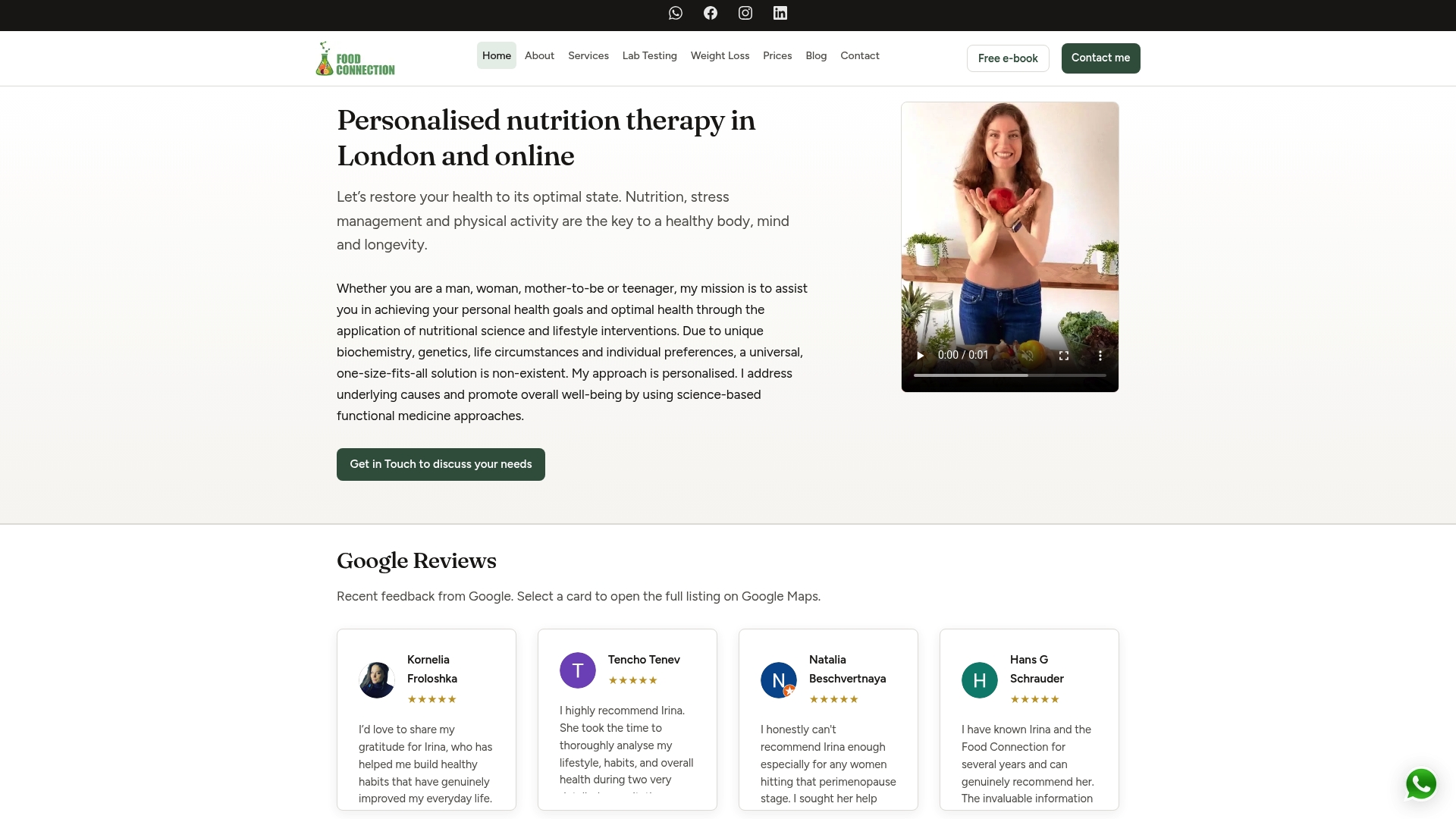
Food Connection’s packages include a 90-minute initial consultation with written personalised recommendations, a follow-up consultation within eight weeks, further one-hour follow-ups as needed, and 12 weeks of dedicated support for clients who want a longer runway. Lab test analysis and interpretation can be added where relevant.
- Read more about services offered, including lab testing.
- Get in touch through Food Connection to arrange an initial consultation.
This article is general information, not a substitute for advice from a qualified doctor. Consult a qualified healthcare professional about your own circumstances before acting on anything here.
Sources
- Personalised nutrition interventions and dietary behaviour change — Food4Me and related evidence (PMC)
- Effectiveness of interventions aimed at improving dietary behaviours among people at higher risk of or with chronic non-communicable diseases: an overview of systematic reviews
- Dietitian — Regulated Professions Service (UK government)
- Nutrition & Dietetics Service | UCLH Integrated Medicine
FAQ
What does ongoing nutrition support actually involve?
It involves an initial assessment of 60 to 90 minutes, a written personalised plan, and a series of follow-up sessions over several weeks to adjust the plan as you progress. Many programmes also offer optional functional lab testing with interpretation included.
How is this different from clinical nutrition support in hospital?
This is a private, programme-based consulting service for adults managing conditions like digestive issues or hormonal imbalance, delivered through consultations and a personalised plan. Clinical nutrition support, such as enteral or parenteral feeding, is a different hospital-based service for patients who cannot eat normally, and this article does not cover it.
How do I check if a nutrition practitioner is properly qualified?
In the UK, “Dietitian” is a protected title, so you can verify a practitioner’s registration with the Health and Care Professions Council before booking. “Nutritionist” is not a protected title in the same way, so checking qualifications and experience directly is worthwhile.
Does personalised nutrition advice actually work better than generic advice?
Evidence from the Food4Me research base shows that personalised nutrition advice improved dietary intake more than generic advice across multiple trials, particularly when combined with behaviour-change techniques. Results for some clinical outcomes remain mixed, and frequent contact with a practitioner is consistently linked to better adherence.
How much does an ongoing nutrition programme typically cost?
At Food Connection, an initial 90-minute consultation with written recommendations costs £150, with follow-up consultations from £80 to £120 depending on timing, and 12 weeks of dedicated support priced at £250. Laboratory testing and one-to-one support are quoted on request.