
MTHFR test meaning: what the result tells you

MTHFR stands for methylenetetrahydrofolate reductase. It is an enzyme your body makes from instructions in the MTHFR gene, and it helps you process folate (vitamin B9). An MTHFR test checks a blood sample for common variants of that gene. A positive result means you carry a variant. It does not mean you are ill. Variants this common rarely explain symptoms on their own, so the useful next step is a look at your whole picture: diet, digestion, thyroid, hormones and energy. That is the work we do in personalised nutrition programmes.
TL;DR
- MTHFR is the name of a gene and of the enzyme it codes for. The enzyme helps convert folate into the form your body uses.
- The test looks for two common variants, C677T and A1298C. Between 60% and 70% of people carry at least one.
- A positive result is not a diagnosis. NHS genetics services say these variants are not causally linked with any disorder.
- Folic acid works as normal for carriers: the standard 400 micrograms a day before and during early pregnancy still applies.
- If you have fatigue, digestive trouble or hormonal symptoms, the answer is usually in your wider diet, lifestyle and blood markers, not in one gene.
Table of Contents
- What MTHFR means and what the gene does
- What an MTHFR test checks
- What a positive or negative result means
- Does the NHS test for MTHFR?
- Is a positive result something to worry about?
- Folate, folic acid and diet after a result
- What to look at if you have symptoms
- Our perspective
- Getting a plan built around you
- FAQ
- Sources
What MTHFR means and what the gene does
The MTHFR gene gives your cells the recipe for an enzyme that converts one form of folate into the main form found in blood. That form is needed for the step that turns homocysteine, an amino acid, into methionine, which your body uses to build proteins and other compounds.
Two different things share the MTHFR name, and mixing them up causes most of the alarm online:
- Homocystinuria is a rare inherited condition. MedlinePlus Genetics notes that at least 40 changes in the gene have been found in people with it. Homocysteine builds up to high levels and it causes serious problems. It is diagnosed in babies and children, not through a consumer test.
- Common variants such as C677T are a different, milder kind of change. They can make the enzyme less stable and, mainly in people with two copies of C677T, raise homocysteine a little.
When people say they “have MTHFR”, they almost always mean the second, very common kind.
What an MTHFR test checks
An MTHFR gene test uses a blood sample to look for the two most common variants, C677T and A1298C. Each of us has two copies of the gene, one from each parent, so the result describes how many copies carry each change.
The NHS East Genomics service reports that 60-70% of people carry at least one of the two variants, and about 10% have two copies of C677T or one copy of each variant. A finding this widespread works more like a trait, such as eye colour, than a fault.
What a positive or negative result means
| Result | What it usually means |
|---|---|
| One copy of either variant | Unlikely to cause health problems |
| Two copies of C677T, or one of each variant | May explain a raised homocysteine level |
| Two copies of A1298C | Probably does not explain a raised homocysteine level |
| Neither variant found | Any raised homocysteine is more likely to come from another cause |
This summary follows MedlinePlus. It adds that when neither variant is found, raised homocysteine is more likely to come from B-vitamin deficiency, certain medicines, older age, an underactive thyroid or kidney disease.
So the result is one small piece of information. The measurable things, such as your homocysteine, B12, folate and thyroid markers, tell you what is happening in your body now. The gene only describes a tendency you were born with.
Does the NHS test for MTHFR?
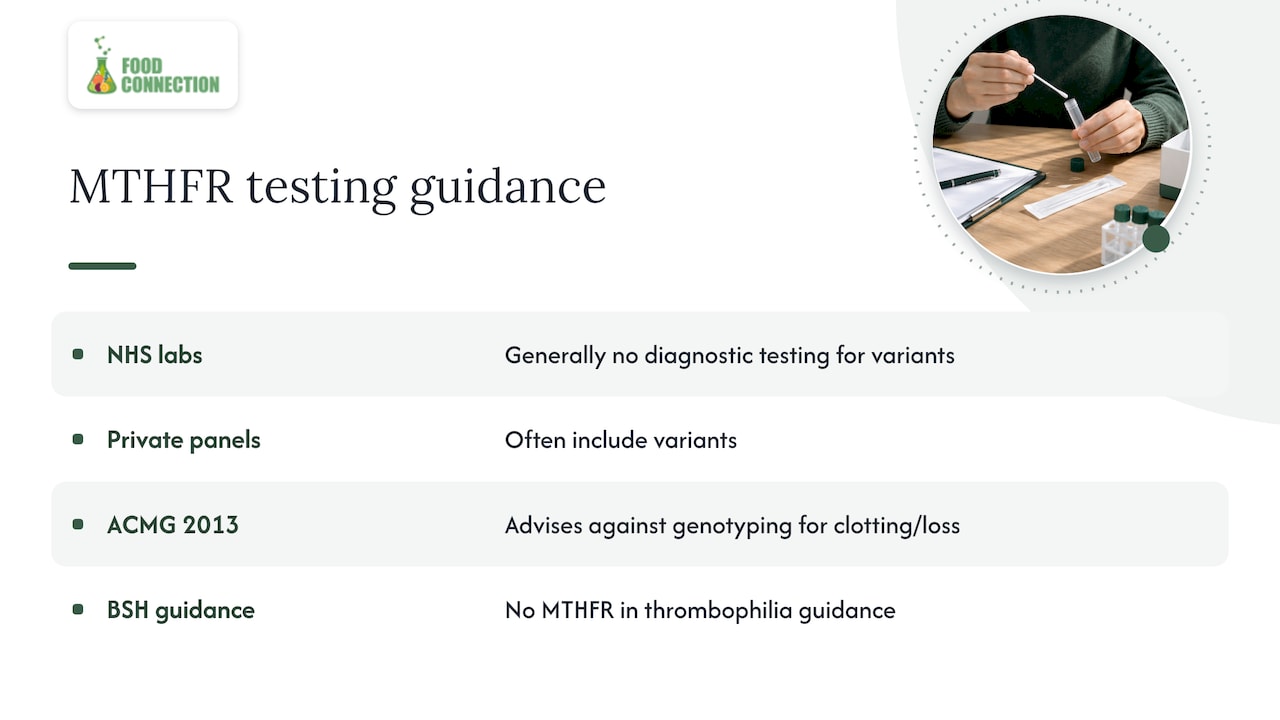
Usually not. East Genomics states that NHS genetics laboratories generally do not offer diagnostic testing for these two variants, although private panels often include them. Its reasoning is that the result adds no clinically useful or actionable information.
This matches a 2013 guideline from the American College of Medical Genetics and Genomics, which advises against ordering MTHFR genotyping as part of work-up for blood clotting problems or recurrent pregnancy loss. It also notes that the British Society for Haematology does not include MTHFR testing in its thrombophilia guidance.
If you want to understand a wider set of blood markers, a general blood test wellness check in London shows what such a visit typically involves. Whichever route you take, the most informative results are the ones that measure what is happening now.
Is a positive result something to worry about?
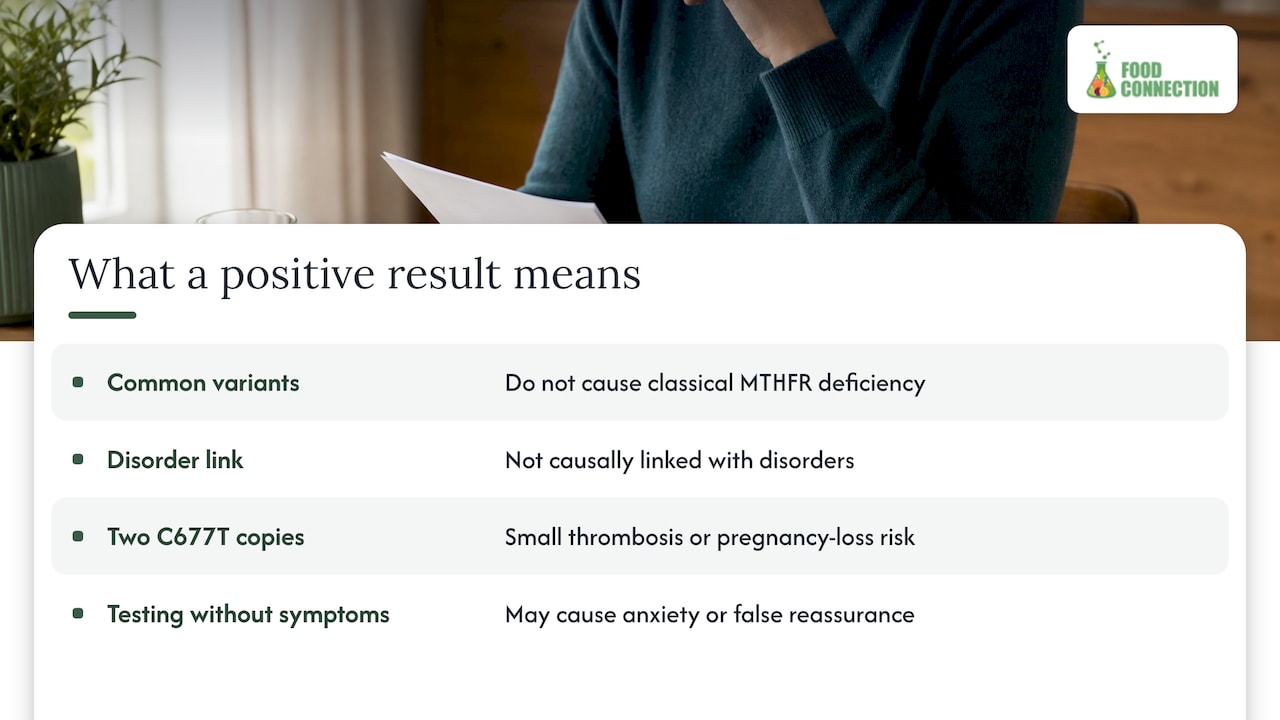
For most people, no. East Genomics says common MTHFR variants do not cause classical MTHFR deficiency, are not causally linked with any disorder, and that any added risk of venous thrombosis or recurrent pregnancy loss in people with two copies of C677T is small.
The Royal Australian College of GPs adds a practical point: in people without symptoms, testing can lead to anxiety, false reassurance and unnecessary follow-up, because the result does not change treatment. If a result has already worried you, the calmer reading is that you share a very common trait with most people.
Folate, folic acid and diet after a result
This is where the genuine, practical advice sits.
Folic acid still works. The CDC states that people with an MTHFR variant can process all forms of folate, including folic acid. At the same intake, people with two copies of C677T have average blood folate only about 16% lower than people without it, and the amount you take matters more than your genotype.
Pregnancy advice does not change. UK guidance from the Scientific Advisory Committee on Nutrition is that all women who could become pregnant should take 400 micrograms of folic acid a day before conception and until week 12, with a higher 5 mg dose for those who have had a pregnancy affected by a neural tube defect. East Genomics says carriers should take the standard dose unless a clinician has another reason to prescribe a high one, and that swapping to other folate forms is not recommended. If you are pregnant or planning to be, speak to your GP or midwife about your dose. Our prenatal nutrition checklist covers the food side.
Food first, for everyone. Leafy greens, pulses, eggs and wholegrains supply folate, and B12 from animal foods or fortified products works alongside it. A varied diet does more for these markers than any single gene result.
What to look at if you have symptoms
Most people who search this term are not curious about genetics. They are tired, bloated, going through perimenopause or struggling with their weight, and they have found “MTHFR” in a list of possible causes. The measurable explanations are often more useful:
- Fatigue and low mood: iron, B12, folate, vitamin D and thyroid function. Our guide to what thyroid test results actually mean explains how to read the numbers.
- Digestive symptoms: food patterns, fibre type, gut markers and how symptoms line up with meals and stress.
- Hormonal changes: sleep, blood sugar, protein intake and, where it is appropriate, hormone testing.
- Raised homocysteine: your GP can measure it, and the cause is worked out from your diet, medicines, thyroid and kidney results.
If you are considering private testing, our UK guide to functional lab testing explains what each type measures and how results are used.
Our perspective
Many people arrive at our consultations with an MTHFR result in hand and a feeling that it explains everything. We understand why. A named cause feels like relief after years of unexplained symptoms.
What we do is widen the lens. Your genes are one input among many. We look at what you eat, how you sleep, how your digestion behaves, what your stress and hormones are doing, and what your blood markers show. Then we build a plan that fits your actual life, so the habits are ones you can keep without added stress.
This is why we work in programmes, not single appointments. Change takes weeks, and you need someone to adjust the plan as your body responds. Our practitioner holds an MSc in Nutrition and is registered with BANT and CNHC, and where lab results are useful we interpret them in the context of you, not a template.
Irina
Getting a plan built around you
If you have been told you carry an MTHFR variant, or you simply want to know why you feel the way you do, we can look at the whole picture with you. The initial consultation lasts one and a half hours and comes with written personalised recommendations, at £150. A follow-up within 8 weeks is £120, later one-hour follow-ups are £80, and 12 weeks of dedicated support is £250.

We also offer laboratory test analysis and interpretation, which you can read about on our services page.
FAQ
What does it mean if you test positive for MTHFR?
It means you carry one or both of the common variants, C677T or A1298C. One copy is unlikely to cause health problems. Two copies of C677T, or one of each, may explain a raised homocysteine level, which a simple blood test can measure.
Does the NHS test for the MTHFR gene?
NHS genetics laboratories generally do not offer diagnostic testing for these two common variants, because the result would not add clinically useful information. Your GP can instead check markers such as homocysteine, B12, folate and thyroid function if there is a reason to.
Do I need a special folate supplement if I carry the variant?
Not on the strength of the result alone. The CDC states that people with MTHFR variants can process folic acid, and NHS genetics advice is to take the standard dose in pregnancy. Ask your GP or pharmacist before changing any supplement.
Is MTHFR something to worry about?
For most people it is not. The variants are extremely common and NHS genetics services do not link them causally with any disorder. If you have ongoing symptoms, they deserve a proper look at diet, lifestyle and blood markers.
Sources
- MTHFR gene: MedlinePlus Genetics
- MTHFR Gene Test: MedlinePlus Medical Test
- MTHFR genetic testing/counselling: East Genomics (NHS)
- ACMG Practice Guideline: lack of evidence for MTHFR polymorphism testing
- RACGP: MTHFR gene testing
- CDC: MTHFR Gene Variant and Folic Acid Facts
- SACN: Draft update on folic acid (2017)