
Gluten Reintroduction: How to Do It Safely and in What Order

The right way to reintroduce gluten depends on why you stopped. If you removed it and have never been tested for coeliac disease, the reintroduction is part of getting a reliable answer, and it should be done in a set amount for a set time. If you already have a diagnosis, it is a different matter and needs your doctor. If you cut gluten out to see how you felt, a structured reintroduction can show you what you actually react to. Our consultations are built around this kind of step-by-step, personalised work, with written recommendations you can follow at home.
TL;DR
- Do not start a gluten-free diet before coeliac testing. Coeliac UK advises eating gluten until a doctor has made a diagnosis.
- If you have already cut gluten out, the 2026 British Society of Gastroenterology (BSG) guideline recommends 3-6g of gluten a day for at least 6 weeks before testing.
- Early symptoms such as bloating, nausea or headache are common and usually ease within a few days.
- Symptoms alone do not tell you whether you have coeliac disease, so testing matters.
- If you have diagnosed coeliac disease or suspect a wheat allergy, speak to your GP or specialist before reintroducing anything.
Table of Contents
- First, work out why you stopped
- The gluten challenge: how much and for how long
- A practical week-by-week routine
- What symptoms can and cannot tell you
- If you cannot face reintroducing gluten
- Reintroduction when coeliac disease is ruled out
- How we approach it
- Support through the process
- FAQ
- Sources
First, work out why you stopped
Three situations look similar from the outside but need different handling.
You have never been tested. Coeliac disease is an autoimmune condition in which gluten damages the lining of the gut. The antibody blood test and the gut biopsy only work while you are eating gluten, so reintroduction comes before testing. NICE guideline NG20 says not to start a gluten-free diet until a specialist has confirmed the diagnosis, even if the blood test is positive.
You have a coeliac diagnosis. Do not reintroduce gluten on your own. Talk to your GP or gastroenterologist about symptoms and next steps.
You suspect a wheat allergy. The BSG guideline advises that a suspected wheat allergy should be formally investigated before any gluten challenge. Allergy reactions can come on quickly, so this is a matter for your GP.
If none of these applies and you simply felt better without gluten, the sections below on pacing and symptom tracking are for you. Even so, it is worth asking your GP whether coeliac testing is sensible first, because stopping gluten can make a later diagnosis harder.
The gluten challenge: how much and for how long
The 2026 BSG guideline recommends 3-6g of gluten daily for at least 6 weeks. Coeliac UK gives the same advice: at least 3g, preferably 6g, every day for six weeks before testing and throughout the diagnostic process.
In food terms, NICE says to eat gluten in more than one meal every day. A hospital patient leaflet from the Royal United Hospitals Bath NHS Foundation Trust suggests aiming for at least two gluten-containing meals a day. Examples include a slice or two of wheat bread at breakfast and a sandwich or pasta later on. Keep the habit steady: a big pasta dinner on Friday and nothing else is not a challenge.
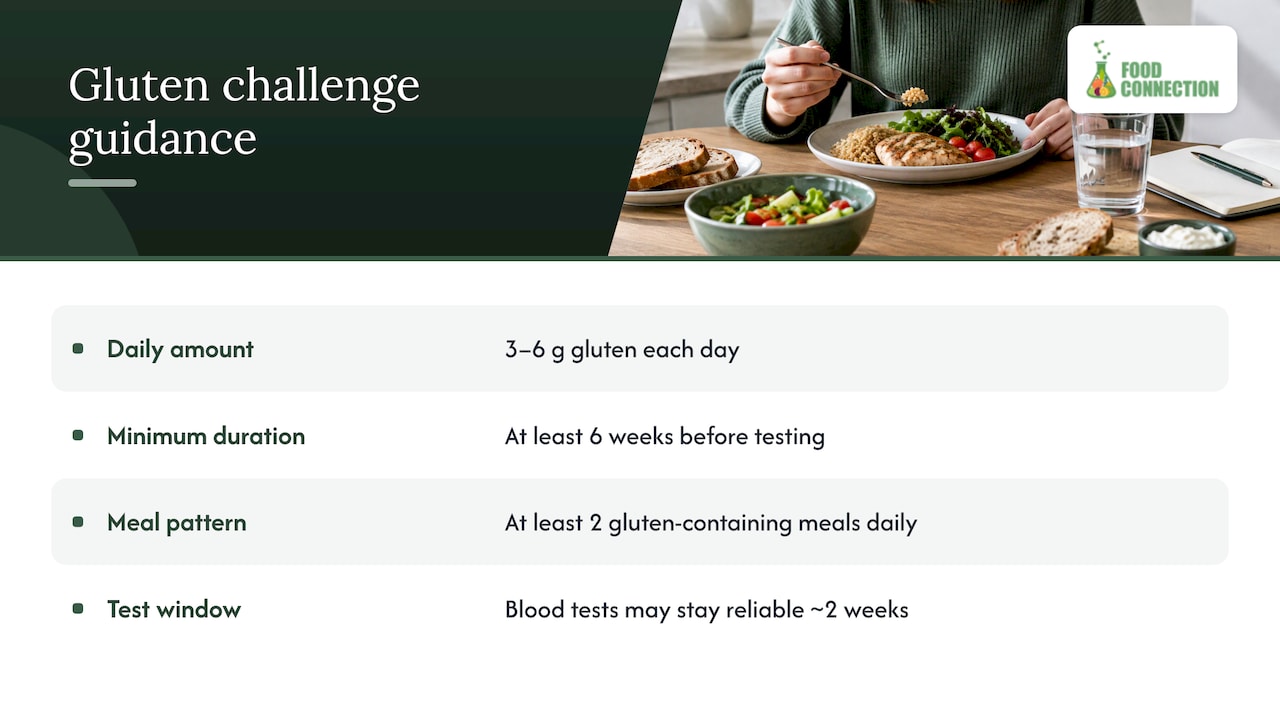
The same leaflet notes that blood tests may remain reliable for about two weeks after going gluten-free, so the sooner you restart after stopping, the better.
A practical week-by-week routine
- Before you start: book a GP appointment. Ask about testing, and about whether a genetic test (HLA-DQ2 and DQ8) is appropriate. Coeliac UK’s summary of the BSG guideline recommends checking these genes before reintroducing gluten. A negative result makes coeliac disease highly unlikely, according to the BSG guideline, and could spare you the challenge. These genes are common, though, found in 30-40% of the Western population, so a positive result does not mean you have the condition.
- Days 1-14: increase gradually. The NHS leaflet suggests building up over a week or two to keep symptoms down, reaching at least two gluten-containing meals a day.
- Weeks 2-6 (at least): hold a steady daily amount. Do not skip days.
- Testing: keep eating gluten until your tests are done. After six weeks at 6g a day, most people show gut damage or cell changes, but antibody levels can take longer to rise, which is why a biopsy is the preferred route after reintroduction.
- Afterwards: only go back to a gluten-free diet once a specialist has confirmed the result.
What symptoms can and cannot tell you
The BSG guideline says early symptoms such as nausea, abdominal pain, diarrhoea, headache and tiredness are common but typically ease within a few days. It also says diarrhoea, fatigue and abdominal pain are poor predictors of recent gluten intake, and that about 20% of patients have no symptoms at diagnosis. In other words, feeling fine does not rule coeliac disease out, and feeling unwell does not prove it.
The 2025 European guideline adds that expectation can influence symptoms in non-coeliac wheat sensitivity. A diary helps here. Note what you ate, the time, and how you felt over the following 24-48 hours: stool pattern, bloating, energy, sleep, skin, mood.
Contact your GP if symptoms become severe. For ideas on easing everyday digestive discomfort during the challenge, this overview of gluten sensitivity symptoms and supplements is a helpful companion.
If you cannot face reintroducing gluten
Some people find it too uncomfortable. NICE says that people who cannot reintroduce gluten before testing should be referred to a gastrointestinal specialist and told that confirming the diagnosis by biopsy may be difficult. NHS inform gives similar advice. Do not push through severe symptoms alone: ask for that referral.
Reintroduction when coeliac disease is ruled out
Once coeliac disease and wheat allergy have been excluded on a gluten-containing diet, the 2025 European guideline says non-coeliac wheat sensitivity may be considered. This is where careful, personalised reintroduction helps most. Wheat contains more than gluten, including fermentable carbohydrates that can trigger IBS-type symptoms, so what you react to may not be gluten at all. Our guides on FODMAP reintroduction and IBS flare foods show how the same stepwise logic works for other triggers.
How we approach it
Many people come to us after trying several diets, with gluten removed as one of them, and no clear answer about what helped. Our approach is programme-based rather than a single appointment: we analyse your lifestyle and symptoms in detail, build a personalised plan, and stay with you while you test foods back in, so that each change is understood rather than guessed.
Where it is relevant, we can arrange functional laboratory tests and interpret them with you. Coeliac testing itself goes through your GP, and we make sure your plan is built around that route, not against it.
Our practitioners hold an MSc in Nutrition and are BANT and CNHC registered. Our aim is that you end up eating as widely and as calmly as your body allows.
Irina
Support through the process
An initial consultation lasts one and a half hours and comes with written personalised recommendations, at £150. A follow-up within 8 weeks is £120, and later one-hour follow-ups are £80. If you want continuous guidance, 12 weeks of dedicated support is £250. See the prices page or our services.
FAQ
Can I start eating gluten again?
If you have never been tested, yes, and you should do so before testing for coeliac disease. If you have a coeliac diagnosis or a suspected wheat allergy, speak to your GP or specialist first.
How long should I eat gluten before a coeliac test?
At least six weeks, at 3-6g a day, according to the 2026 BSG guideline and Coeliac UK. That is roughly gluten in at least two meals daily.
Should I increase gluten slowly?
The NHS leaflet suggests building up over a week or two to reduce symptoms, then reaching at least two gluten-containing meals a day.
Does a genetic test replace the challenge?
Not always, but a negative HLA-DQ2 and DQ8 result makes coeliac disease highly unlikely and may avoid the need for a challenge. Ask your GP whether it suits your situation.
Sources
- Coeliac Disease Diagnosis: Tests and Steps, Coeliac UK
- 2026 British Society of Gastroenterology guidelines
- NICE NG20 Recommendations
- Gluten: How much is needed for coeliac disease testing? RUH NHS
- BSG guideline highlights, Coeliac UK
- BSG guideline, Gut 2026
- ESsCD 2025 updated guidelines
- Coeliac disease, NHS inform