
GI MAP test UK: buying and interpretation guide

The GI-MAP (Gastrointestinal Microbial Assay Plus) is a qPCR-based stool test that analyses a broad panel of gut biomarkers, developed by Diagnostic Solutions Laboratory. If you are in the UK and want to order one, the short answer is: yes, you can, but not through your GP. You will need a private clinic or a practitioner-led provider. Foodconnection is one UK option that supplies the kit and includes a clinician interpretation, which matters more than most buyers realise before they see the report.
Table of Contents
- What is the GI-MAP test?
- What does the GI-MAP panel measure?
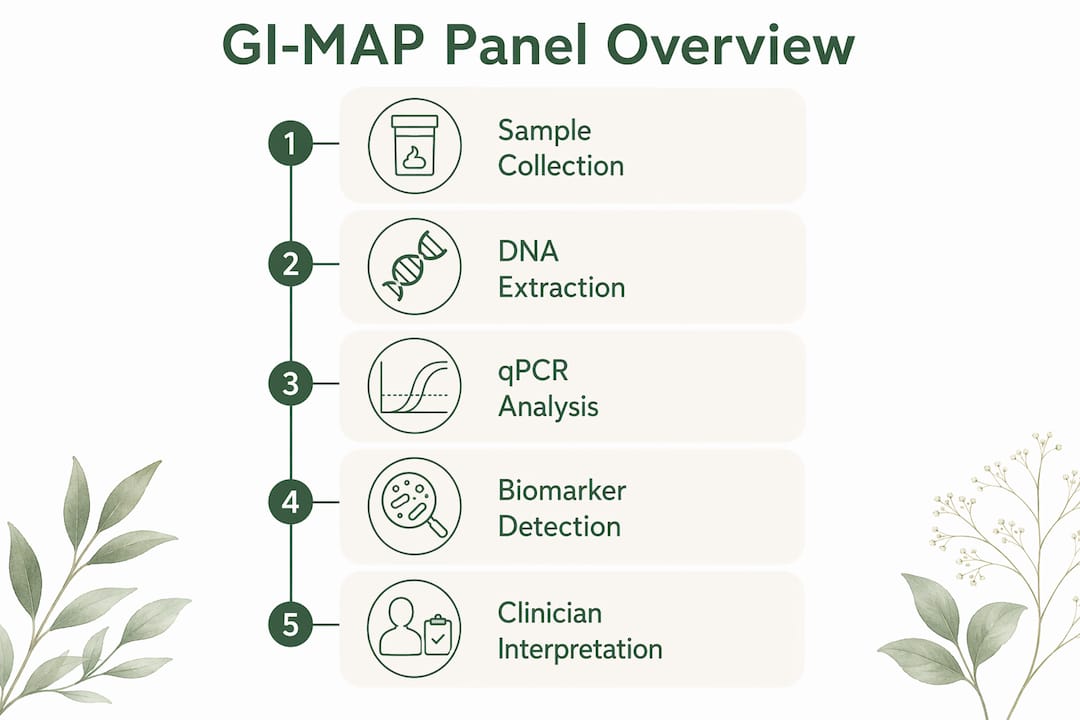
- How does the GI-MAP test work?
- Who typically benefits from the GI-MAP?
- How do you obtain a GI-MAP in the UK and what does it cost?
- How does the at-home sample collection work?
- What does the GI-MAP report contain and why does interpretation matter?
- What are the limits and accuracy caveats of the GI-MAP?
- What is the typical turnaround time?
- Why do practitioners choose the GI-MAP?
- Key takeaways
- Why interpretation changes everything
- Foodconnection’s GI-MAP service for UK clients
- Useful sources and further reading
What is the GI-MAP test?
The full name is Gastrointestinal Microbial Assay Plus. Diagnostic Solutions Laboratory, a US-based specialist diagnostics company, developed the assay and remains the laboratory that processes every sample. The test sits firmly in the functional and integrative medicine space, ordered by nutritional therapists, functional medicine practitioners, and private gastroenterologists who want a detailed picture of a patient’s gut ecology rather than a basic pathogen screen.
Key differences from standard NHS stool tests include quantitative results that provide numerical loads for organisms, a broad panel covering pathogens and markers, and use of sensitive DNA-based qPCR methodology not reliant on organism viability.
What does the GI-MAP panel measure?
The panel covers 85+ biomarkers across six broad categories. The table below gives a quick orientation; the bullets underneath add clinical context.
| Category | Examples of markers |
|---|---|
| Pathogenic bacteria | C. difficile, Campylobacter, Salmonella, E. coli |
| Commensal and opportunistic bacteria | Akkermansia muciniphila, Bacteroides fragilis, Klebsiella spp. |
| Parasites | Giardia, Cryptosporidium, Blastocystis hominis |
| Fungi and yeast | Candida spp., Geotrichum |
| Viruses | Norovirus, adenovirus, rotavirus |
| Inflammation and digestion markers | Calprotectin, secretory IgA (SIgA), pancreatic elastase-1 |
A few points worth knowing before you order:
- H. pylori gets its own section. The panel reports not just whether H. pylori is present but also virulence factors and antibiotic resistance markers, which directly informs treatment choices. That level of detail is absent from most standard breath tests.
- Calprotectin, SIgA and pancreatic elastase are immune and digestive markers not included on many basic stool panels. Calprotectin flags intestinal inflammation; elastase-1 indicates whether the pancreas is producing sufficient digestive enzymes.
- Zonulin (a marker of intestinal permeability) is available as an add-on in some package tiers rather than the standard panel.
How does the GI-MAP test work?
The method is quantitative polymerase chain reaction, or qPCR. In plain terms: the lab extracts DNA from your stool sample, then amplifies and counts specific genetic sequences belonging to target organisms. Because the process is quantitative, the result is a number, not just a flag.

| Method | Result type | Sensitivity for pathogens | Ecological microbiome profiling |
|---|---|---|---|
| Culture | Qualitative / semi-quantitative | Moderate (organism must be viable) | Poor |
| Standard PCR | Qualitative (positive/negative) | High | Limited |
| qPCR (GI-MAP) | Quantitative | High | Moderate |
| metagenomics | Qualitative / relative abundance | High | Excellent |
The practical implication of quantitation is significant. A clinician looking at a validated quantitative result can decide whether a low-level finding warrants monitoring or active treatment. With a binary positive/negative result, that clinical judgement is much harder to make. Metagenomics gives richer ecological data but is considerably more expensive and less standardised for clinical use in the UK at present.
Who typically benefits from the GI-MAP?
The test is not a general wellness screen. It is most useful when there is a clinical question that a detailed gut picture can help answer.
Common indications:
- Chronic IBS-type symptoms (bloating, altered bowel habit, cramping) that have not responded to standard dietary changes. If you have been struggling with persistent IBS symptoms for months without a clear cause, this test can surface microbial drivers that a GP stool test would miss.
- Unexplained diarrhoea or constipation, particularly if recurrent.
- Suspected parasitic infection following travel or exposure.
- Systemic symptoms with a plausible gut link: skin conditions, fatigue, recurrent infections, or autoimmune presentations where a practitioner wants to assess gut barrier function and inflammation.
- Persistent bloating or food intolerances that worsen despite elimination diets.
When to pause or reconsider:
- During or immediately after a course of antibiotics. Recent antibiotic use can suppress organism loads and produce misleading results; discuss timing with your ordering clinician.
- As a first-line investigation for acute severe illness. Blood in stool, high fever, or signs of systemic infection need urgent NHS or GP assessment, not a posted stool kit.
- If you are looking for a standalone answer. The GI-MAP is most useful when a practitioner will interpret results and build a treatment plan around them. Without that context, a detailed quantitative report can generate more anxiety than clarity.
How do you obtain a GI-MAP in the UK and what does it cost?
The GI-MAP is not available on the NHS. A GP can occasionally order specialist stool investigations through NHS microbiology, but these are culture-based and cover a narrow pathogen list. The GI-MAP specifically requires a private route.
Ordering routes in the UK:
- Private clinic or nutritional therapy practice that holds a practitioner account with Diagnostic Solutions Laboratory or a UK distributor. The clinic procures the kit, ships it to you, and typically includes a results consultation. This is the most clinically supported route.
- Practitioner-ordered via a functional medicine or integrative GP practice. The clinician orders on your behalf; you collect at home and return the sample directly.
- Private lab sellers acting on behalf of clinicians. Some online providers sell the kit with a nominal clinician sign-off but without a substantive interpretation service. Read the small print carefully before ordering this way.
Cost considerations for UK buyers:
Package pricing varies by provider and by which markers are included. The standard panel, a standard panel with zonulin, and an H. pylori profile are the three main package tiers, each at a different price point. UK providers typically price in pounds sterling, and the total cost usually covers the kit, return postage, and lab processing. Interpretation, however, is frequently sold separately or bundled into a wider consultation package. Always confirm with your provider whether a results consultation is included before you pay.
Private health insurance in the UK rarely covers functional stool testing of this type. Some corporate health cash plans may reimburse part of the cost; check your policy wording. There is no NHS referral pathway for the GI-MAP.
Pro Tip: Ask any provider three questions before ordering: Is a clinician interpretation included? Who processes the sample and where? What is the chain-of-custody procedure for the return sample?
How does the at-home sample collection work?
The process is straightforward, but a few practical steps make a real difference to result quality.
- Order the kit. Your provider ships a collection device, instructions, a stabilisation vial, and a prepaid or tracked return envelope.
- Prepare before collecting. Stop probiotics at least two to three days before collection unless your clinician advises otherwise. Avoid fish oil and certain supplements on the day of collection if instructed. Do not collect during or within two weeks of completing antibiotics unless your clinician has specifically requested it.
- Collect the stool sample. Use the collection device provided. You do not need a large sample; the kit specifies the volume. Avoid contamination with urine or toilet water.
- Transfer to the stabilisation vial. The vial contains a DNA-preserving buffer that keeps the sample stable at room temperature for a defined period. Follow the instructions on timing.
- Label the sample correctly. Write your name, date of birth, and collection date clearly. Mislabelled samples are a common reason for processing delays.
- Package and post promptly. Post the sample early in the week, ideally Monday to Wednesday, to avoid the sample sitting in a postal depot over a weekend. Keep it away from direct heat before posting.
- Notify your provider. Some providers ask you to log the dispatch date in a patient portal so the lab can track the incoming sample.
Sample stability is one of the GI-MAP’s practical strengths. The DNA-preserving buffer means the sample does not need refrigeration during transit, which makes at-home collection genuinely workable for UK patients posting to a processing lab.
What does the GI-MAP report contain and why does interpretation matter?
The report is detailed. Most patients see it and immediately want a clinician to walk them through it, which is exactly the right instinct.
A typical GI-MAP report includes:
- Quantitative organism results for each target, displayed against a reference range. Results are colour-coded to indicate whether a finding is within range, mildly elevated, or significantly elevated.
- H. pylori section with virulence factor genes and, where tested, antibiotic resistance markers that guide whether standard triple therapy is likely to work.
- Inflammation and immune markers: calprotectin, SIgA, and anti-gliadin antibodies where included.
- Digestive function markers: pancreatic elastase-1 and, in some packages, beta-glucuronidase.
- Interpretive commentary in some versions, though the depth of this varies by package.
The numbers themselves are only half the story. A clinician reviewing the report will weigh each finding against your symptoms, medication history, and diet before deciding what, if anything, to treat. A mildly elevated Candida result in a patient with no symptoms and a healthy diet may warrant dietary tweaks and monitoring. The same result in someone with chronic fatigue, brain fog, and recurrent thrush points toward a more active intervention. That clinical judgement cannot come from the report alone.
Foodconnection’s lab testing service bundles the GI-MAP kit with a clinician-led results consultation and a personalised nutrition plan, which is the kind of structured follow-through that turns a report into a treatment direction.

Pro Tip: Before your interpretation appointment, write down your top five symptoms and when they started. A clinician can correlate your report findings with your symptom timeline far more precisely when you arrive prepared.
What are the limits and accuracy caveats of the GI-MAP?
qPCR is genuinely sensitive, but sensitivity is not the same as clinical certainty.
- DNA detection does not confirm active infection. qPCR detects genetic material, including from organisms that are no longer viable. A positive result for a pathogen needs clinical correlation before treatment is initiated.
- Recent antibiotics distort results. Because qPCR detects DNA fragments, it may pick up residual genetic material from organisms killed by a recent antibiotic course, or conversely, it may show suppressed loads that do not reflect the patient’s baseline.
- Sampling variation exists. Microbial distribution in stool is not perfectly uniform. A single sample captures one moment in time; some organisms fluctuate day to day.
- False negatives are possible at very low organism burdens or if the sample was not collected or preserved correctly.
- The test does not diagnose disease. A GI-MAP result showing elevated calprotectin, for example, is a signal to investigate further, not a diagnosis of inflammatory bowel disease. Conditions such as Crohn’s disease or colorectal cancer require endoscopy and histology, not a stool DNA test.
Red flag symptoms that need urgent NHS assessment, not a posted stool kit:
- Blood in stool (bright red or dark/tarry)
- Unintentional weight loss
- High fever with severe abdominal pain
- Symptoms that wake you from sleep
- Progressive worsening over a short period
The GI-MAP fits best as one component of a broader diagnostic pathway, not as a standalone answer.
What is the typical turnaround time?
From ordering to receiving results, the total timeline depends on several steps. Diagnostic Solutions Laboratory’s white paper notes that lab processing can be as little as five days once the sample arrives. Add shipping time in both directions and the total window from ordering to results is usually several weeks, though this varies.
The practical breakdown looks like this: kit delivery to you takes a few days; you collect and post; the sample travels to the processing lab; the lab processes and uploads results; your provider notifies you and books an interpretation appointment. UK postal times and public holidays can add days at any stage.
A few scheduling tips worth noting: post your sample early in the week to avoid weekend delays; check whether your provider uses a UK-based processing partner or ships internationally, as the latter adds transit time; and book your interpretation appointment in advance so you are not waiting weeks after results arrive.
Why do practitioners choose the GI-MAP?
The clinical case for qPCR-based stool testing rests on two things: sensitivity and quantitation.
“The GI-MAP provides truly quantitative values with validated assays and reproducibility measures, enabling clinicians to distinguish clinically significant elevations from low-level findings that may not require intervention.” — Diagnostic Solutions Laboratory, GI-MAP White Paper
That distinction matters in practice. A qualitative test tells you an organism is present. A quantitative test tells you how much of it is there, which is the information a clinician actually needs to decide whether to treat, monitor, or disregard a finding. Validated cutoffs mean the thresholds are not arbitrary; they are derived from reference populations.
The 85+ biomarker panel also means a single sample can surface pathogenic bacteria, parasites, fungi, viruses, and immune markers simultaneously, rather than requiring multiple separate tests. For a patient who has been symptomatic for months without a clear diagnosis, that breadth is clinically efficient.
The honest caveat is that qPCR is not the right tool for every question. For rich ecological microbiome profiling, sequencing technologies give more granular data on microbial diversity. The GI-MAP is optimised for clinical pathogen detection and quantitative marker reporting, not for academic microbiome research. Practitioners who understand that distinction use it well.
Key takeaways
The GI-MAP is a qPCR-based stool test covering 85+ biomarkers, available in the UK through private practitioners, and most useful when paired with a clinician-led interpretation.
| Point | Details |
|---|---|
| What the GI-MAP is | A quantitative PCR stool test covering 85+ biomarkers, developed by Diagnostic Solutions Laboratory. |
| Who should order it | People with chronic IBS symptoms, suspected parasites, or systemic issues with a plausible gut link, not general wellness screening. |
| How to get it in the UK | Through a private clinic or practitioner; not available on the NHS and not suitable for self-directed ordering without interpretation support. |
| Lab processing time | As little as five days once the sample reaches the lab; total order-to-results window is typically three to four weeks including shipping. |
| Foodconnection’s offering | Foodconnection supplies the GI-MAP kit with a clinician interpretation and personalised nutrition plan for UK clients. |
Why interpretation changes everything
Most people who order a GI-MAP do so because they have been symptomatic for a long time and standard testing has not given them answers. That is a completely reasonable reason to pursue it. What surprises many of them is how much the report itself asks of the reader.
A page of quantitative microbial loads, reference ranges, and virulence factor flags is not self-explanatory, even for people who have done a lot of their own research. The clinical value of the test is not in the detection; it is in what a knowledgeable practitioner does with the numbers. A finding of elevated Blastocystis hominis, for instance, might be treated aggressively in one clinical context and simply monitored in another, depending on symptom severity, immune markers, and the patient’s history. The test cannot make that call. The practitioner can.
There is also a sequencing question that gets overlooked. Treating a pathogen without addressing the underlying conditions that allowed it to thrive, whether that is poor diet, chronic stress, or impaired digestion, tends to produce temporary results. A good interpretation appointment does not just explain what the report shows; it builds a plan that addresses root causes alongside any direct treatment.
One client who came to Foodconnection with years of unexplained bloating and fatigue had a GI-MAP that showed significantly elevated calprotectin alongside a parasitic finding. The combination pointed toward active intestinal inflammation rather than simple dysbiosis. The resulting plan combined targeted antiparasitic support with an anti-inflammatory dietary protocol and a follow-up retest at twelve weeks. The retest showed normalised calprotectin and clearance of the parasite. That outcome required the test and the interpretation working together.
Foodconnection’s GI-MAP service for UK clients
If you have read this far and you are ready to order, the question is not just where to get the kit but what support comes with it. Foodconnection offers a complete lab testing package that covers the GI-MAP kit, sample logistics guidance, a clinician-led results consultation, and a personalised nutrition plan built around your findings. Follow-up checks are included in the programme structure, so you are not left managing a complex report on your own.
The service is designed for people who want answers and a clear plan, not just data. Pricing is listed on the services page, where you can also see the full range of functional lab options and book a consultation. If your gut symptoms have been going on long enough that you are researching stool DNA testing, it is worth speaking to a practitioner who can tell you whether the GI-MAP is the right starting point or whether another test should come first.
Useful sources and further reading
For readers who want to go deeper on the technical or clinical detail:
- Diagnostic Solutions Laboratory — GI-MAP product page: The primary source for panel contents, biomarker list, and ordering information. Start here for the definitive marker list.
- GI-MAP White Paper (Diagnostic Solutions Laboratory): Technical document covering qPCR methodology, analytical validation, reproducibility data, and the clinical rationale for quantitative reporting. Useful if you want to understand the science behind the results.
- GI-MAP FAQ page: Covers at-home collection logistics, turnaround expectations, and practitioner requirements. Practical reading before you order.
- Designs for Health — GI-MAP clinical resource: A clinical distributor’s overview of the panel, including antibiotic resistance and virulence factor reporting, written for practitioners.
- NHS.uk — Stool tests: For context on what standard NHS stool investigations cover and when to seek urgent assessment for red flag symptoms. Useful for understanding where the GI-MAP sits relative to NHS diagnostic pathways.