
Fatty liver diet: what to eat, avoid, and change

The most effective approach to managing fatty liver disease combines the Mediterranean diet with regular physical activity, moderate calorie reduction, and a clear limit on alcohol. That combination is not a suggestion; it is what the clinical evidence consistently points to, and it is what NHS guidance recommends for non-alcoholic fatty liver disease (NAFLD), now increasingly referred to as metabolic dysfunction-associated steatotic liver disease (MASLD).
Here is what that looks like in practice:
- Eat more: vegetables, oily fish, legumes, whole grains, nuts, and olive oil
- Cut back on: saturated fats, refined carbohydrates, added sugars, sugary drinks, and processed meats
- Move more: at least 150 minutes of moderate exercise each week
- Lose weight gradually: a 7–10% reduction in total body weight is linked to meaningful reductions in liver fat and, in some cases, regression of fibrosis
- Limit alcohol: no more than 14 units per week, and less if possible
- Avoid crash diets: rapid weight loss can worsen liver inflammation
These are not abstract targets. Each one has a direct, measurable effect on liver fat and metabolic health. The sections below explain why, and how to put them into practice.
Table of Contents
- What is fatty liver disease, and should you be concerned?
- Which foods help your liver, and which make things worse?
- How exercise and weight loss reverse fatty liver disease
- How fatty liver disease is diagnosed and treated medically
- Why personalised nutrition consulting makes a real difference
- A sample fatty liver meal plan to get you started
- Do nutritional supplements help with fatty liver disease?
- How to track your progress and know it is working
- Foodconnection offers personalised support for fatty liver management
- Key takeaways
What is fatty liver disease, and should you be concerned?
Fatty liver disease occurs when excess fat accumulates in liver cells. In most cases it develops gradually, driven by a combination of poor diet, physical inactivity, and underlying metabolic conditions. NAFLD and its newer clinical name MASLD cover the same spectrum: from simple steatosis (fat in the liver with minimal inflammation) through to non-alcoholic steatohepatitis (NASH), fibrosis, and ultimately cirrhosis if left unmanaged.
The condition is often asymptomatic until it reaches an advanced stage. Many people live with it for years without knowing, which is precisely why early dietary intervention matters so much. By the time symptoms such as fatigue, discomfort in the upper right abdomen, or unexplained weight gain appear, the disease may already have progressed.
Major risk factors include obesity, insulin resistance, type 2 diabetes, high cholesterol, and a sedentary lifestyle. Excess calorie intake, particularly from refined carbohydrates and added sugars, drives fat synthesis in the liver even in people who are not clinically obese. If you have been told your liver enzymes are elevated, or if you carry weight around your abdomen and have any of the metabolic risk factors above, taking dietary action now is far more effective than waiting for symptoms.
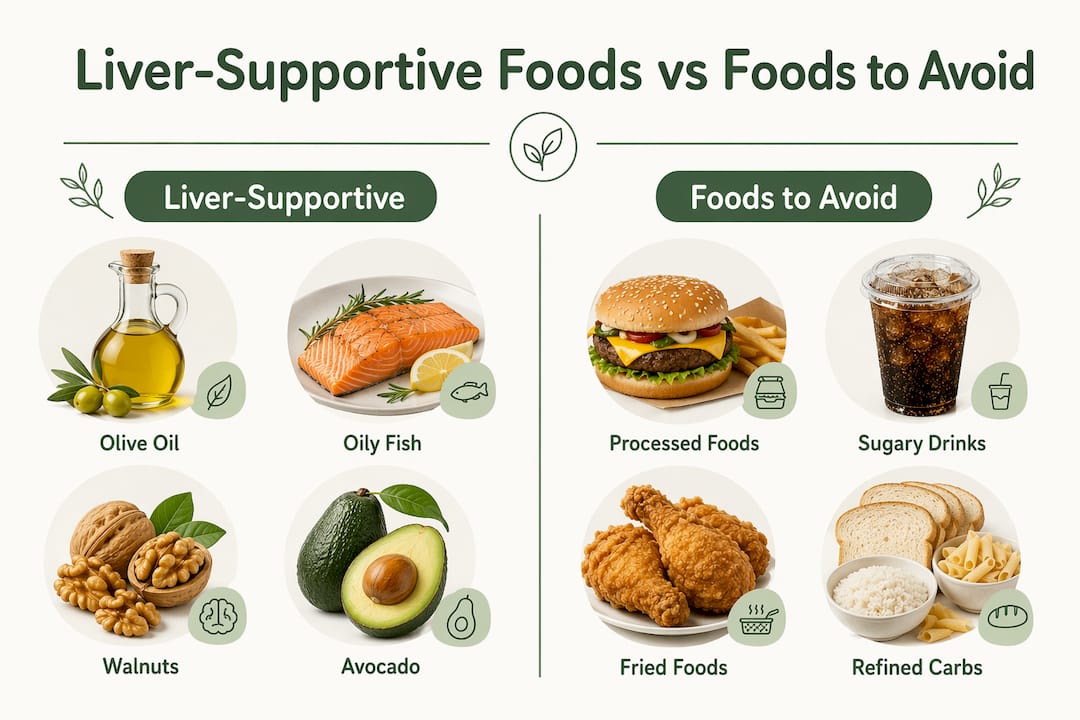
Which foods help your liver, and which make things worse?
The Mediterranean diet is the preferred nutritional pattern for MASLD. It is not a rigid meal plan; it is a way of eating built around whole, minimally processed foods, healthy fats, and plenty of plant variety. The evidence behind it for liver health is stronger than for any other dietary approach.
Foods to prioritise
- Oily fish (salmon, sardines, mackerel, herring): rich in omega-3 fatty acids that reduce liver fat and inflammation; aim for at least three portions a week
- Vegetables: at least three servings daily, with a focus on non-starchy varieties such as broccoli, spinach, courgette, and asparagus
- Legumes and pulses: lentils, chickpeas, kidney beans, and peas provide fibre and plant protein that support metabolic health
- Whole grains: brown rice, oats, barley, and wholegrain bread over their refined equivalents
- Nuts and seeds: walnuts, almonds, chia seeds, and flaxseed in unsalted, raw form; four servings a week is a reasonable target
- Olive oil: the primary cooking fat in the Mediterranean pattern; use it in place of butter or processed vegetable spreads
- Polyphenol-rich drinks: black coffee and green tea contain antioxidants that research associates with reduced liver fat
Foods to limit or avoid
Cutting down on processed foods, sugary snacks, and fried takeaway meals reduces liver strain and supports healing. More specifically:
- Sugary drinks and fruit juices: liquid sugar bypasses satiety signals and drives liver fat synthesis rapidly
- Refined carbohydrates: white bread, crisps, pastries, and most breakfast cereals spike blood glucose and insulin
- Saturated and trans fats: fatty cuts of meat, butter, full-fat processed cheese, and anything with “hydrogenated” on the label
- Processed and red meats: sausages, bacon, deli meats, and hot dogs
- Alcohol: the NHS recommends a maximum of 14 units per week for the general population, but for those with established fatty liver disease, less is better and abstinence may be advised
Quick comparison: liver-supportive vs liver-stressing foods
| Category | Liver-supportive choices | Foods to limit |
|---|---|---|
| Fats | Olive oil, oily fish, walnuts, avocado | Butter, lard, processed spreads, fried foods |
| Protein | Salmon, sardines, legumes, eggs, chicken | Sausages, bacon, processed deli meats |
| Carbohydrates | Oats, brown rice, barley, lentils | White bread, crisps, pastries, sugary cereals |
| Drinks | Water, black coffee, green tea | Fizzy drinks, fruit juice, alcohol, energy drinks |
| Snacks | Raw nuts, seeds, fresh fruit | Biscuits, chocolate bars, crisps, sweets |
Pro Tip: Swap your cooking oil to extra-virgin olive oil and replace one meat-based meal per week with oily fish. These two changes alone shift your fat intake in the right direction without requiring a complete dietary overhaul.
How exercise and weight loss reverse fatty liver disease
Physical activity and weight management are not optional extras in a fatty liver treatment plan. They are central to it. The NHS recommends at least 150 minutes of moderate-intensity exercise per week, spread across most days. That means brisk walking, cycling, swimming, or anything that raises your heart rate without leaving you breathless.

The weight loss target is specific. Research shows that losing 7–10% of total body weight correlates with a measurable reduction in liver steatosis and, in more advanced cases, regression of fibrosis. Achievable, but only through sustained change rather than a crash diet.
Exercise also improves insulin sensitivity independently of weight loss, which matters because insulin resistance is one of the primary drivers of liver fat accumulation. Even without significant weight change, regular physical activity reduces liver fat and improves metabolic markers.
Practical approaches that work:
- Start with 20–30 minute walks and build gradually; consistency beats intensity at the start
- Add resistance training two to three times a week to improve muscle mass and metabolic rate
- Use a personalised weight loss programme to set realistic targets and track progress
- Avoid prolonged sitting; breaking up sedentary time with short movement breaks has measurable metabolic benefits
- Pair exercise with dietary changes rather than relying on either alone
How fatty liver disease is diagnosed and treated medically
Diagnosis typically begins with a blood test showing elevated liver enzymes (ALT and AST), followed by an ultrasound scan to detect fat in the liver. In more complex cases, a FibroScan (transient elastography) or MRI may be used to assess the degree of fibrosis. Liver biopsy remains the most definitive diagnostic tool but is reserved for cases where the degree of damage is unclear from imaging alone.
There is currently no approved medication that specifically reverses fatty liver disease. Lifestyle modification, centred on diet and weight loss, remains the cornerstone of treatment across all clinical guidelines, including those of the NHS and the British Liver Trust.
That absence of a pharmacological fix is not a gap in the system; it reflects the fact that dietary and lifestyle changes, when sustained, are genuinely effective. The liver has a remarkable capacity for regeneration, particularly in the earlier stages of disease.
Monitoring typically involves repeat blood tests every six to twelve months and periodic imaging to track liver fat and fibrosis. If the disease has progressed to advanced fibrosis or cirrhosis, specialist hepatology input is required. For most people with early-stage NAFLD, however, a GP-led approach supported by a dietitian or nutrition professional is entirely appropriate. Research into liver health policy increasingly emphasises the value of structured multidisciplinary support in achieving sustained outcomes.
Why personalised nutrition consulting makes a real difference
Generic dietary advice is easy to find and hard to follow. The gap between knowing what to eat and actually changing how you eat is where most people struggle, and it is where structured, personalised dietary plans consistently outperform generic guidance. Plans that account for cultural food preferences, economic constraints, cooking skills, and daily routine achieve better adherence and better outcomes.
Foodconnection works with clients on exactly this basis. Rather than handing over a standard meal plan, the approach begins with a detailed lifestyle and dietary analysis, identifying the specific patterns driving liver fat accumulation in that individual. The programme then builds a realistic, sustainable eating pattern around the person’s actual life, with ongoing support and adjustments as progress is made.
The benefits of working with a nutrition professional rather than going it alone:
- Accountability: regular check-ins make it far harder to revert to old habits
- Personalisation: food choices are adapted to your preferences, not a template
- Clinical context: functional laboratory testing can identify underlying metabolic issues that generic advice misses
- Sustainable pace: small, gradual dietary shifts tailored to your lifestyle achieve better long-term results than restrictive diets
- Behavioural support: understanding why you eat the way you do is as important as knowing what to eat
Pro Tip: If you find yourself reverting to old eating habits after a few weeks, the issue is rarely willpower. It is usually that the plan was not adapted to your actual life. A personalised programme that fits around your schedule, budget, and food preferences is far more likely to stick.
A sample fatty liver meal plan to get you started
The plate method is a practical starting point: fill half your plate with non-starchy vegetables, one quarter with whole grains or starchy vegetables, and one quarter with lean protein such as fish, poultry, or legumes. This structure, recommended in clinical guidance for MASLD, keeps portions balanced without requiring calorie counting.
Sample day:
Breakfast: Porridge made with oat milk, topped with walnuts and fresh berries. Black coffee or green tea.
Lunch: Lentil and vegetable soup with a slice of wholegrain bread. A small handful of almonds on the side.

Snack: Sliced cucumber, celery, and carrot with hummus.
Dinner: Baked salmon fillet with brown rice and steamed broccoli, dressed with olive oil and lemon. Decaffeinated green tea.
Dessert: Greek yogurt with fresh raspberries.
This is not a rigid prescription. The goal is a pattern: oily fish several times a week, vegetables at every meal, whole grains over refined ones, and olive oil as the primary fat. Swap the salmon for sardines or mackerel, the lentil soup for a chickpea stew, the brown rice for barley. Variety within the Mediterranean framework is a feature, not a complication.
Do nutritional supplements help with fatty liver disease?
The honest answer is: possibly, but not reliably enough to replace dietary change. Clinical guidelines advise increasing dietary omega-3 through food rather than supplementation for MASLD, because the evidence for supplemental omega-3 specifically reversing liver fat is less consistent than the evidence for whole-food sources.
Vitamin E has attracted research interest for its potential to reduce liver inflammation in NASH, but current guidance is cautious. The Mayo Clinic notes that while some studies suggest benefit, the evidence is not yet strong enough to recommend routine supplementation, and high-dose vitamin E carries its own risks. The same applies to other supplements marketed for liver health, including milk thistle (silymarin) and berberine. Some show promise in small studies; none has the evidence base to justify replacing dietary change.
The practical takeaway: do not spend money on liver supplements before addressing the dietary patterns that caused the problem. If you are considering supplementation, discuss it with a GP or registered nutrition professional first, particularly if you are on other medications.
How to track your progress and know it is working
Monitoring progress with fatty liver disease is not just about how you feel. The liver can improve significantly without producing noticeable symptoms, which means objective markers matter.
Blood tests are the most accessible measure. Falling ALT and AST levels indicate reduced liver inflammation. Your GP should repeat these every six to twelve months once dietary changes are underway.
Weight and waist circumference are practical proxies for metabolic improvement. Tracking weekly weight at the same time of day, and measuring waist circumference monthly, gives a clearer picture than the scales alone.
Energy and digestion often improve before blood tests reflect the change. Better sleep, less afternoon fatigue, and improved digestion are early signals that the dietary shift is working. If you find yourself struggling with afternoon energy crashes, that is often a sign that blood sugar regulation is still unstable, which directly affects liver fat metabolism.
Imaging (ultrasound or FibroScan) is the definitive way to confirm liver fat reduction, but it is typically repeated annually rather than monthly. Use it as a longer-term checkpoint rather than a short-term motivator.
Keep a simple food and symptom diary for the first four to eight weeks. It does not need to be detailed; noting what you ate, how you felt, and your energy levels is enough to identify patterns and make targeted adjustments.
Foodconnection offers personalised support for fatty liver management
Changing your diet for a medical condition is different from general healthy eating. It requires understanding your specific metabolic picture, your food history, and the practical realities of your daily life. Generic meal plans rarely account for any of that.
Foodconnection’s nutrition consulting programmes are built around exactly this kind of individual assessment. Each programme begins with a detailed analysis of your current diet and lifestyle, identifies the specific drivers of your condition, and builds a realistic eating plan you can sustain. For clients with fatty liver disease, that often includes functional laboratory testing to assess metabolic markers, alongside structured dietary guidance aligned with NHS and clinical recommendations.
The programme-based model means you are not left to implement changes alone after a single appointment. Ongoing support, regular check-ins, and plan adjustments as your health improves are built into the process. If you are ready to move from knowing what you should eat to actually making it work for your life, book a consultation with Foodconnection to get started.
Key takeaways
A fatty liver diet built around the Mediterranean pattern, combined with gradual weight loss and regular exercise, is the most evidence-backed approach to reducing liver fat and preventing disease progression.
| Point | Details |
|---|---|
| Mediterranean diet is the priority | Emphasise vegetables, oily fish, legumes, whole grains, and olive oil as the dietary foundation. |
| Weight loss target is specific | Losing 7–10% of total body weight is linked to liver fat reduction and fibrosis regression. |
| Exercise is non-negotiable | At least 150 minutes of moderate activity weekly improves insulin sensitivity and reduces liver fat independently of weight loss. |
| No approved medication exists | Lifestyle and dietary change remain the cornerstone of treatment; supplements do not replace them. |
| Personalised support improves outcomes | Foodconnection’s programme-based nutrition consulting builds sustainable plans tailored to your individual metabolic profile and lifestyle. |
Recommended
- Why do I crash in the afternoon? | FoodConnection blog
- Perimenopause: what’s happening and how food can help | FoodConnection blog
- Eating Healthy But Not Losing Weight? 5 Hidden Reasons Why | FoodConnection blog
- How to Choose the Right Nutritionist in London (And Avoid Costly Mistakes) | FoodConnection blog