
Cortisol saliva test: collect, read results, get support

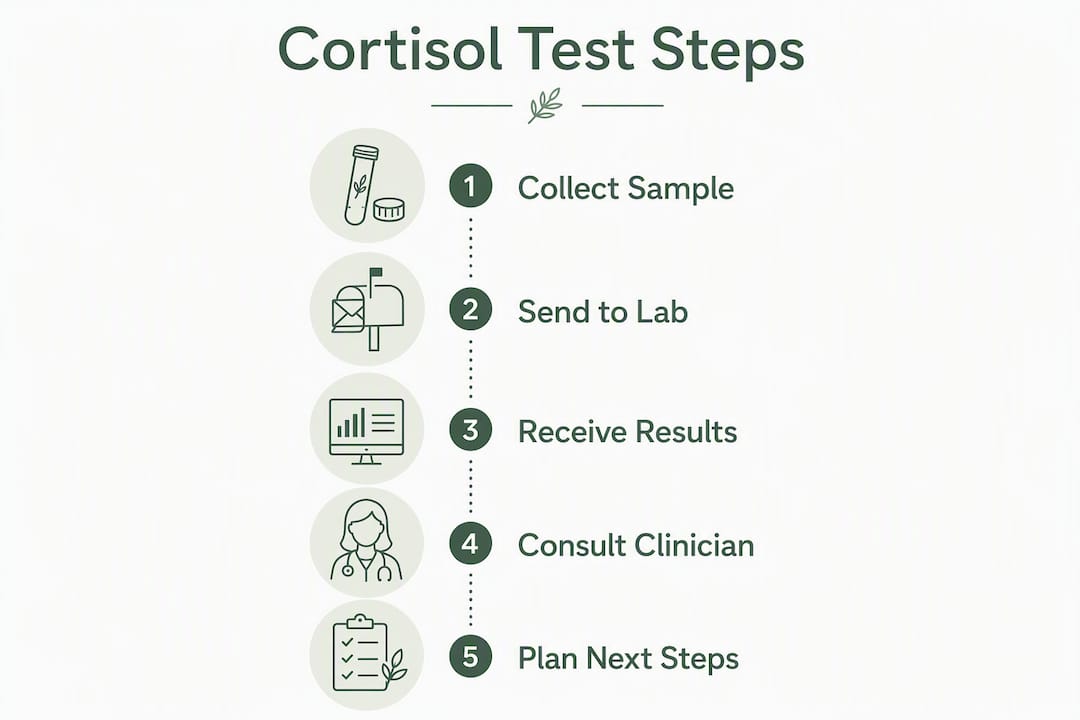
A cortisol saliva test measures free, bioavailable cortisol — the fraction your cells can actually use — by analysing saliva collected at specific times across the day. The single most important practical point: one reading tells you almost nothing. What matters is the pattern across multiple timepoints, a diurnal curve that shows whether your cortisol rises sharply in the morning and falls steadily by bedtime, or whether that rhythm has flattened or gone wrong somewhere in between.
Quick summary for UK readers:
- Who uses it: People investigating chronic fatigue, unexplained weight changes, poor sleep, stress-related symptoms, or suspected adrenal dysfunction; also used in perimenopause and hormonal workups.
- Common sample schedules: A four-point diurnal panel (waking, midday, evening, bedtime) maps the full daily rhythm; a single late-night sample screens specifically for Cushing syndrome.
- If results look abnormal: Do not act on them alone. Take the report to your GP or a qualified clinician. Abnormal saliva results typically trigger confirmatory testing — blood cortisol, 24-hour urinary free cortisol, or a dexamethasone suppression test.
- Lab quality matters: Look for UKAS-accredited or ISO-certified laboratory analysis and access to clinician interpretation before you buy any home kit.
Table of Contents
- What does a cortisol saliva test actually measure?
- Which type of saliva cortisol test is right for your question?
- How to collect saliva samples at home correctly
- How are results reported and what do clinicians look for?
- What are the limitations of saliva cortisol testing?
- Where can you get a cortisol saliva test in the UK?
- How much does a cortisol saliva test cost in the UK?
- How do clinicians use salivary cortisol in practice?
- Key takeaways
- Saliva testing works best when results lead somewhere
- Foodconnection: lab testing, interpretation, and a plan that follows
- Useful sources and further reading
What does a cortisol saliva test actually measure?
Cortisol circulates in two forms. Most of it — roughly 90% — is bound to proteins in the blood and biologically inactive. The remaining free fraction crosses into saliva and is the portion your tissues respond to. A diurnal cortisol test captures this free, bioavailable fraction directly, which is why salivary values correlate well with physiological activity rather than simply reflecting total hormone load.
The diurnal rhythm is the core clinical signal. In a healthy pattern, cortisol peaks sharply within 30–45 minutes of waking — the cortisol awakening response — then declines steadily through the day, reaching its lowest point around bedtime. Typical morning salivary cortisol runs 10.2–27.3 nmol/L; by bedtime, a healthy nadir sits at roughly 2.2–4.1 nmol/L. That steep descent is what clinicians are looking for.
“A single static cortisol measurement has limited value. The diurnal slope and pattern are the clinically useful signals — a flattened slope is a common red flag for HPA-axis dysfunction.” — NCBI Bookshelf clinical overview
A flattened curve — where morning values are lower than expected and evening values higher than they should be — suggests dysregulation of the hypothalamic-pituitary-adrenal (HPA) axis. This pattern appears in chronic stress, burnout, sleep disruption, and some adrenal conditions. Elevated late-night cortisol, even when morning values look normal, is a separate red flag with its own clinical implications. Neither pattern is diagnosable from a single blood draw taken at an arbitrary time of day, which is precisely why the multi-sample saliva approach exists.
Which type of saliva cortisol test is right for your question?
The format you need depends on what you are trying to find out. Three main test types cover most clinical and personal health scenarios.
Four-point diurnal panel collects samples at waking, midday, evening, and bedtime. This is the standard format for rhythm assessment and the one most private home kits use. Research protocols sometimes use six samples per day for finer resolution, but a four-point panel gives clinicians enough data to plot a meaningful curve. Use this when your question is: is my cortisol rhythm normal across the day?
Late-night salivary cortisol uses a single sample collected around midnight. It is a validated screening tool for Cushing syndrome and can be more sensitive than plasma cortisol or 24-hour urine for mild or early cases. The logic is straightforward: cortisol should be at its lowest late at night, so any elevation at that point is clinically significant. A single late-night sample is not designed to map rhythm — it is a targeted screen.
Waking series for cortisol awakening response (CAR) involves collecting two or three samples in the first 30–45 minutes after waking, without getting out of bed. This is used more often in research and specialist clinical settings than in standard private panels, but some functional medicine practitioners request it to assess adrenal reactivity specifically at waking.
“Diurnal tests are less suitable for people with erratic sleep schedules or shift work, because standard timepoints may not reflect their circadian rhythm.” — Medical News Today
The practical trade-off is straightforward. A four-point panel is the most convenient and gives the broadest picture. A late-night single sample is simpler but narrower in scope. If you are unsure which applies to your situation, a clinician or qualified nutrition consultant can advise before you spend money on the wrong test.
How to collect saliva samples at home correctly
Timing and preparation are where most home collections go wrong. A contaminated or poorly timed sample does not just give a slightly inaccurate result — it can be rejected by the laboratory entirely or produce values that lead to incorrect clinical decisions.
Step-by-step collection checklist:
- Check your kit instructions the evening before and confirm you have all collection tubes or swabs, labels, and a cool bag or access to a refrigerator.
- On each collection day, note the exact time you wake and set alarms for your scheduled timepoints.
- Do not eat, drink (other than plain water), brush your teeth, or use mouthwash for at least 30–60 minutes before each sample.
- Wash your hands before handling any collection device.
- If using a swab, place it under your tongue and allow it to saturate fully — the swab must be visibly wet and heavy with saliva. Partially saturated swabs frequently yield insufficient volume for LC-MS/MS assays and are rejected or flagged by the laboratory.
- If using a tube, follow the passive drool method described in your kit instructions until the required volume is reached.
- Label each sample immediately with the date, time, and timepoint number.
- Refrigerate samples promptly after collection. Do not leave them at room temperature for extended periods.
- Follow your kit’s postal instructions carefully. Most UK providers include a pre-paid tracked envelope and specify a posting day to avoid samples sitting in a sorting office over a weekend.
Common errors that invalidate samples:
- Gum bleeding or recent flossing — blood contamination artificially raises salivary cortisol because serum cortisol is far higher than salivary cortisol
- Eating or drinking within the required window before collection
- Using mouthwash or antiseptic rinse before sampling
- Incomplete swab saturation
- Heavy exercise within two hours of collection
- Smoking or nicotine use shortly before sampling
- Applying topical steroid creams or inhalers without informing your clinician
Pro Tip: Avoid brushing or flossing within 60 minutes of any collection timepoint — this is the single most common cause of contaminated samples. If your gums bleed easily, tell your clinician or the lab before testing, as this may affect result validity.
Tell your clinician or nutrition consultant about all medications, including topical corticosteroids, inhaled steroids, and hormonal contraceptives, before testing. Several of these can directly affect cortisol values or interfere with the assay.

How are results reported and what do clinicians look for?
Most private UK lab reports present a table of your cortisol values at each timepoint in nmol/L, alongside the laboratory’s reference range for that timepoint, and a plotted diurnal curve so you can see your pattern visually. The curve is where the interpretation lives.
A normal result shows a high morning value that falls progressively through the day to a low bedtime reading. The slope should be steep and consistent. Three patterns prompt clinical attention:
- Flattened slope: Morning cortisol is lower than expected and evening values are higher than they should be, narrowing the gap between peak and nadir. This pattern is associated with HPA-axis dysregulation, chronic stress, and burnout.
- Elevated late-night cortisol: Even when daytime values look unremarkable, a raised bedtime or midnight reading is a red flag. It is the primary signal clinicians look for when screening for Cushing syndrome.
- Globally elevated or suppressed values: All timepoints above or below the reference range, rather than just a shifted slope, suggest a different clinical picture and usually prompt faster escalation.
“Clinicians often follow abnormal saliva screening with confirmatory provocative tests such as the dexamethasone suppression test and/or 24-hour urinary free cortisol to establish a formal diagnosis.” — Mayo Clinic Laboratories
After an abnormal panel, the typical next steps in UK clinical practice include:
- Repeat the saliva panel on a different day to rule out acute stress or collection error
- 24-hour urinary free cortisol measurement
- Dexamethasone suppression test (low-dose overnight or two-day protocol)
- Morning serum cortisol and ACTH
- Imaging referral (pituitary MRI or adrenal CT) if biochemical confirmation of Cushing or adrenal pathology is established
Red flag: Markedly elevated late-night values, very high absolute cortisol across all timepoints, or results accompanied by clinical signs such as central weight gain, easy bruising, new hypertension, or proximal muscle weakness warrant prompt GP or endocrine review — not a wait-and-see approach.

What are the limitations of saliva cortisol testing?
Saliva testing is genuinely useful for rhythm mapping and initial screening. It is not a standalone diagnostic tool for adrenal disease, and several factors can distort results enough to make them misleading.
Sources of false or unreliable results:
- Blood contamination from gum disease, recent brushing, or flossing (falsely elevated values)
- Incomplete sample volume (rejected by the lab or flagged as insufficient)
- Acute psychological stress or anxiety at the time of collection (transiently raised cortisol)
- Caffeine consumed close to collection time
- Nicotine use
- High-intensity exercise within two hours of sampling
- Topical corticosteroids, inhaled steroids, or systemic steroid medications
- Certain antidepressants and other medications that affect HPA-axis activity
Beyond contamination, there are structural limits to what saliva testing can confirm. Home saliva kits are appropriate for screening and monitoring but do not replace clinical diagnostic assessment. A saliva panel showing elevated late-night cortisol does not confirm Cushing syndrome — it raises the clinical suspicion that then requires biochemical confirmation through blood and urine testing, and often imaging.
People with erratic sleep schedules or shift work present a particular challenge: standard diurnal timepoints are anchored to conventional sleep-wake cycles, so their results may look abnormal simply because their circadian rhythm is shifted, not because their adrenal function is impaired.
When to prefer other tests or specialist referral: if you have clinical signs strongly suggestive of Cushing syndrome or adrenal insufficiency, if your saliva panel is markedly abnormal on two separate collections, or if your GP has already identified a clinical indication, blood and urine testing through an NHS or private endocrinology pathway is the appropriate route rather than a home kit.
Where can you get a cortisol saliva test in the UK?
Three procurement routes exist for UK residents, each with different implications for cost, turnaround, and clinical support.
NHS/GP referral is available when there is a clinical indication — symptoms consistent with adrenal disease, Cushing syndrome, or adrenal insufficiency. Your GP can request serum cortisol and, where appropriate, refer to endocrinology for specialist testing. NHS saliva cortisol testing is less commonly offered than blood cortisol, but it does exist in specialist centres. The Sheffield Biomedical Research Centre and NHS endocrine units can access validated salivary cortisol assays. The NHS route costs you nothing directly but requires a clinical indication and may involve waiting times.
Private home kit providers send a collection kit to your address, you post samples back to an accredited laboratory, and results arrive digitally within a few days. This is the most accessible route for people who want to map their rhythm without a GP referral.
Private clinics offer testing as part of a broader consultation, usually with clinician interpretation built in. Cost is higher, but you get immediate professional context for your results.
Provider checklist — what to verify before buying:
| Criterion | What to look for |
|---|---|
| Laboratory accreditation | UKAS accreditation for the analysing lab |
| Analytical method | LC-MS/MS preferred over immunoassay for accuracy and specificity |
| Sample timing instructions | Clear, timed collection schedule with at least four timepoints for a diurnal panel |
| Clinician interpretation | Access to a qualified clinician or nutrition consultant to review results |
| Sample handling guidance | Refrigeration instructions, cold-chain postal packaging, and a specified posting day |
| Turnaround time | Stated clearly before purchase; typically 5–10 working days for private panels |
If a provider cannot confirm laboratory accreditation or does not offer any form of clinician review, look elsewhere. A result without interpretation is of limited practical use.
How much does a cortisol saliva test cost in the UK?
Private diurnal saliva panels typically cost in the region of £75–£100 for a standard four-point kit, though prices vary by provider and the number of samples included. Late-night single-sample tests tend to sit at the lower end of that range. Panels that include clinician interpretation or a follow-up consultation are priced higher.
Practical cost and timing notes:
- NHS testing is via clinical referral; there is no direct cost to the patient, but access depends on clinical indication and GP discretion.
- Private home kits: roughly £75–£100 for a four-point diurnal panel; prices for extended panels or those bundled with interpretation vary.
- Laboratory turnaround for private saliva panels is typically 5–10 working days from sample receipt.
- Postal transit adds 1–2 days; post samples on a Monday or Tuesday to avoid weekend delays at sorting offices.
- Most private health insurance policies do not cover home saliva kits purchased directly by the patient; check your policy before assuming reimbursement.
- NHS testing does not carry a patient cost but is not available on demand without clinical justification.
How do clinicians use salivary cortisol in practice?
Endocrinologists treat the diurnal slope as the primary diagnostic signal, not any single value. A morning reading in isolation, even a very high one, is difficult to interpret without knowing what happens to cortisol by evening. The slope — how steeply cortisol falls across the day — is what distinguishes a normal stress response from a dysregulated HPA axis.
“Salivary cortisol is particularly valuable in outpatient settings because it captures the free hormone fraction across the natural daily rhythm without requiring hospital attendance for timed blood draws.” — NCBI Bookshelf
In endocrinology, abnormal saliva results are never acted on in isolation. The standard clinical pathway after an abnormal panel runs roughly as follows:
| Step | Action |
|---|---|
| 1. Repeat saliva panel | Confirm the pattern on a separate day to exclude acute stress or collection error |
| 2. 24-hour urinary free cortisol | Provides integrated daily cortisol output independent of timing errors |
| 3. Dexamethasone suppression test | Assesses HPA-axis suppressibility; low-dose overnight protocol is standard first step |
| 4. Morning serum cortisol and ACTH | Differentiates adrenal from pituitary origin if suppression test is abnormal |
| 5. Imaging | Pituitary MRI or adrenal CT once biochemical confirmation is established |
Nutrition clinicians use saliva results differently. Rather than diagnosing adrenal disease, they look at the diurnal pattern to inform the timing and composition of dietary interventions. A client with a flattened slope and poor morning cortisol may benefit from protein-rich breakfasts, specific adaptogenic support, and structured sleep hygiene — interventions that are meaningless without knowing where in the day the rhythm breaks down. When results suggest pathology rather than functional dysregulation, a qualified nutrition clinician will refer to a GP or endocrinologist rather than attempt to manage the pattern through diet alone.
For people exploring cortisol’s role in weight distribution or navigating perimenopause-related hormonal shifts, saliva cortisol mapping can be a genuinely useful starting point — provided results are interpreted in the context of a full clinical and lifestyle picture, not read in isolation.
Key takeaways
A cortisol saliva test is most useful as a rhythm map, not a single diagnostic number — collect multiple timed samples, use an accredited lab, and always take abnormal results to a clinician.
| Point | Details |
|---|---|
| Use multiple samples | A four-point diurnal panel (waking, midday, evening, bedtime) gives a clinically meaningful curve; one reading does not. |
| Preparation is critical | Avoid food, drink, brushing, and flossing for 30–60 minutes before each sample; blood contamination falsely raises results. |
| Know the red flags | Elevated late-night cortisol or a globally raised panel with clinical symptoms warrants prompt GP or endocrine review. |
| Verify lab accreditation | Only use a provider whose laboratory holds UKAS accreditation and uses LC-MS/MS analysis. |
| Foodconnection adds interpretation | Foodconnection pairs saliva cortisol testing with clinician-reviewed interpretation and a personalised nutrition plan, so results translate into concrete next steps. |
Saliva testing works best when results lead somewhere
Most people who order a home cortisol kit do so because they have already noticed something is off — persistent fatigue that sleep does not fix, weight that accumulates despite reasonable eating, or a stress response that feels permanently switched on. The test itself is the easy part. What actually requires skill is knowing what to do with a flattened slope at 3 PM or a bedtime value that refuses to drop.
The conventional advice is to “discuss results with your GP,” which is correct but incomplete. A GP appointment is the right move when results suggest pathology. But for the much larger group of people whose saliva panel shows functional dysregulation rather than disease — a slightly flattened curve, a sluggish morning peak, a stress pattern that is real but not diagnostic — a GP visit often ends with reassurance and no clear plan.
This is where the saliva test’s value gets lost. The rhythm information is genuinely useful: it tells you when in the day your cortisol is behaving unusually, which directly informs when to eat, how to structure exercise, what sleep interventions are most likely to help, and whether certain nutritional strategies are worth trying. None of that requires a diagnosis. It requires someone who knows how to read the curve and translate it into a practical programme.
The other thing worth saying plainly: a single saliva panel is a snapshot. Cortisol is exquisitely sensitive to acute stress, poor sleep the night before, and even the anxiety of doing the test itself. A pattern that looks alarming on one collection day may look quite different two weeks later under different conditions. Clinicians repeat abnormal results for exactly this reason. If your first panel comes back unusual, resist the urge to catastrophise — and resist the equally unhelpful urge to dismiss it. Repeat it, then act on the confirmed pattern.
Foodconnection: lab testing, interpretation, and a plan that follows
If your cortisol results have left you with more questions than answers, Foodconnection offers a structured path from test to action. The service coordinates functional lab testing — including salivary cortisol panels — and pairs every result with clinician-reviewed interpretation and a personalised nutrition programme built around your specific pattern.
Where a home kit gives you a number, Foodconnection gives you context: what your diurnal curve means for your energy, sleep, and weight; which dietary and lifestyle interventions are timed to your rhythm; and when results indicate that a GP or endocrine referral is the right next step. The programme-based approach means you are not left managing a complex result alone after a one-off consultation.
To enquire about saliva cortisol testing with interpretation, or to book a one-to-one consultation, visit the Foodconnection services page and get in touch directly.
Useful sources and further reading
The following authoritative sources are worth consulting alongside any lab report, and are useful to bring to a GP or clinician appointment:
- MedlinePlus: Cortisol Test — plain-language overview of cortisol testing from the US National Library of Medicine, covering when tests are ordered and how results are used.
- Mayo Clinic Laboratories: Salivary Cortisol (SALCT) — detailed test catalogue entry including preparation requirements and reference ranges.
- ARUP Laboratories: Cortisol by LC-MS/MS, Salivary — specimen handling requirements, collection instructions, and analytical method details.
- NCBI Bookshelf: HPA Axis and Cortisol — peer-reviewed clinical overview of HPA-axis physiology and the diagnostic value of diurnal cortisol patterns.
- Medical News Today: Diurnal Cortisol Test — accessible explainer covering procedure, preparation, costs, and limitations.
- Healthline: Diurnal Cortisol Test — covers what the test measures, typical ranges, and how results are interpreted.
- Sheffield Teaching Hospitals NHS Foundation Trust — NHS research context on advances in adrenal insufficiency testing in the UK.
- PubMed — peer-reviewed research on salivary cortisol methodology and clinical applications.
Take your lab report to your GP or treating clinician for formal interpretation. This article provides general information, not medical advice, and does not replace a professional clinical assessment.
Recommended
- Cortisol and weight: what’s really driving your belly fat | FoodConnection blog
- Perimenopause: what’s happening and how food can help | FoodConnection blog
- Functional lab testing — stool, hormones, thyroid, SIBO | FoodConnection
- Nutrition services — one-to-one support, lab analysis, yoga | FoodConnection